Showing posts with label ...debut: 1967. Show all posts

Sunday, December 27, 2020

Final Card: Gus Gil

Here’s infielder Gus Gil, sporting the new Pilots’ uniform on a late-series card. 

Gil was signed by the Reds in 1959, and played 8 seasons in their minor-league system, including the last 3 in triple-A.

After the 1966 season, the Indians purchased his contract and installed him as their Opening-Day 2nd baseman for 1967. After starting 19 consecutive games, he was benched in favor of Pedro Gonzalez. When Gonzalez and Chico Salmon failed to get the job done, Gus started the first 4 games in July, but by mid-month was sent to the minors until a September recall.

Gil spent all of 1968 in the minors, then was traded to the expansion Pilots in May 1969 for infielder Chuck Cottier. He started 27 games at the hot corner and another dozen at 2nd base, but by mid-season the Pilots settled on John Donaldson at 2nd and Tommy Harper at 3rd base. 
 
Gus hung on with the Brewers for parts of 1970 and 1971, then played for the Astros’ AAA team from 1972-74. 
 
After splitting the 1975 season between the AAA clubs of the Dodgers and Padres, he played in Mexico in 1976 before retiring. 
 
Gil passed away in 2015 at age 76.

Wednesday, April 15, 2020

Mike Lum (#514)

Mike Lum first appeared on a "National League Rookies" card in the 1968 set.

He made his major-league debut in September 1967. He was signed by the Milwaukee Braves in 1963, and after 5 seasons in the minors (and his Sept '67 cup of coffee), he made the team in 1968.

Lum was the 3rd outfielder, behind Felipe Alou (CF) and Hank Aaron (RF). However, he played less than half as many innings as they did, and was so close to the next two (Tito Francona and Tommie Aaron) that they could all be considered third outfielders as they manned left field during Rico Carty's 1-year absence.


With Carty's return in 1969 plus the acquisitions of Tony Gonzalez and Bob Aspromonte, left field was quite crowded, leaving Lum with little to do but pinch-hit.  Of his 121 games, he only started 32, across all three positions.

Alou was traded away after 1969 but that just gave Gonzalez more playing time in 1970. In 1971 the Braves’ outfield was completely revised. Gone were Hank Aaron (moved to 1B), Gonzalez, and Carty. In were Lum (RF), Sonny Jackson (CF) , and Ralph Garr (LF).

Mike got 350 to 500 at-bats every season through 1975 while splitting his time between the outfield and first base.

After the 1975 season he was traded to the Reds for shortstop Darrel Chaney.  He spent the next 3 seasons as the Reds' 4th outfielder. (When the first three are named Foster, Geronimo, and Griffey, that means you are a pinch-hitter.)

Lum was granted free agency after 1978 and returned to the Braves as a backup 1st baseman and pinch-hitter. Released in May 1981, he pinch-hit for the Cubs for the rest of that season.

Mike played in Japan in 1982, then began a long coaching career. He was a hitting coach for the Braves, White Sox, Giants, and Royals from 1983-89. Since 1990 Lum has been a minor-league instructor for the White Sox, Brewers, and Pirates.

Sunday, September 29, 2019

Ted Kubiak (#281)

Ted Kubiak was a utility infielder for 10 seasons (1967-76), mostly with the Athletics. He had a card in every set from 1968 to 1977.

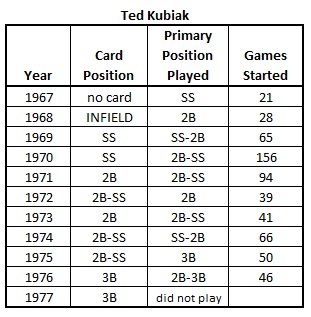
I am most familiar with his 1968 card, which denoted his position as “INFIELD”. So when I saw this 1969 card naming him as a shortstop, I was all ready to rip Topps for promoting him to one position, until I checked into his record today (see chart below).

Kubiak was signed by the Kansas City Athletics in 1961 and made his major-league debut in April 1967. Early in his career he was mostly a fill-in at 2nd base and shortstop.

Why did the Topps airbrushers use BLACK on many of the Athletics' caps in 1968 and 1969? Was green not available?

In December 1969 he was traded to the Brewers for pitcher Diego Segui and shortstop Ray Oyler.

1970 was Ted’s only year as a full-season regular. He started 156 games, playing almost every game at shortstop until moving over to 2nd base in mid-June.

Kubiak also started 77 of the first 104 games in 1971. Beginning at 2nd base, he moved back over to shortstop in early June. By the end of July he was traded to the Cardinals in a 5-player deal that saw Jose Cardenal and Dick Schofield head to Milwaukee.

Ted finished up the season with St Louis but was traded to the Rangers in November for pitcher Joe Grzenda. By mid-season in 1972 he was heading back to Oakland. As he bounced from team-to-team, he never again saw the regular playing time he had in 1970 and early 1971.

His final move was in May 1975, dealt to the Padres for pitcher Sonny Siebert. Ted was primarily a 3rd baseman with San Diego, a position he had rarely played previously. He played every day for his first month with the Padres, then returned to a utility role until retiring following the 1976 season.


Except for the transition from 1968 season to 1969 card, Topps was pretty accurate with the positions on Kubiak’s cards:

Monday, September 23, 2019

Final Card: Jose Herrera

This is the only card for Expos' outfielder Jose Herrera (#378). He had a very brief career (essentially just a few dozen games in '68 and '69). If I wasn’t on a mission to feature all the "final cards" in the 1969 set I probably would have passed over him.

Herrera was signed by the Houston Colt .45s in 1964. After 5 seasons in the minors (he did play 5 games in 1967 and 27 games in Aug/Sept 1968 for the Astros), the Expos selected him in the expansion draft.


Jose did not make the fledgling Expos' squad at the start of the 1969 season, but did play 47 games with them over the 2nd half of the season. This included 30 starts in the outfield and some pinch-hitting appearances.

1970 was a bust for him. He got one at-bat on Opening Day, then spent the rest of the season in the minors. In mid-June he was traded to the Brewers for pitcher John O'Donoghue.

In May 1971 Milwaukee shipped him out to the Tigers (with pitcher John Gelnar) for pitcher Jim Hannan. Herrera finished out the '71 season with the Tigers' AAA Toledo Mud Hens.

He wrapped up his career playing in Mexico from 1972-75.

Although he only had one Topps card, I found this custom card today on Pinterest:

Monday, May 27, 2019

Final Card: Ramon Webster

This is Ramon Webster's 3rd and final Topps baseball card (#618). He did not have as much playing time with the Athletics as I had expected before writing this.

Ramon was signed by the Kansas City Athletics in 1963. After 4 seasons in the minors he made his major-league debut in April 1967.

There were no Athletics' first basemen included in the 1967 Topps set, except for the two featured on Athletics' Rookies Stars cards (Webster and Randy Schwartz). Schwartz had cups of coffee in September 1965 and 1966, but was never heard from again. Webster had no prior major-league experience until appearing in April 1967.


The Athletics began the '67 season with Webster alternating at first base with Danny Cater. In June they reacquired Ken Harrelson (who was their 1st-sacker for much of 1965-66) from the Senators. When manager Al Dark was canned in late-August, Harrelson soon followed, and Webster had the position to himself for the rest of the season.

Ramon started 49 games in the first half of 1968, but played the 2nd half of the season in triple-A, only returning to Oakland in September.

He faded further in 1969, only starting 9 games while most of his 64 games were pinch-hitting appearances. He also played in the minors for most of May.

During Spring Training in 1970 he was traded to the Padres for shortstop Roberto Pena. After playing 95 games for the Padres in 1970, bizarre things started happening. He was sold back to the Athletics in October 1970, only to be repurchased by San Diego in April 1971, who then returned him to Oakland 3 weeks later.

The following month he was acquired by the Cubs, and played in 16 games (all but 1 as a pinch-hitter), the last coming on 8/21/71.

Webster played for the Athletics' AAA team from 1972-75, and in Mexico during 1976. After not playing for 2 years, he played briefly for Panama in the Inter-American League in 1979.

Sunday, December 2, 2018

Final Card: Luis Alcaraz

This makes 2 consecutive Royals, which I usually try to stay away from. But I’m wrapping up the remaining "final cards" in the 1969 set and over the next 20 cards to be posted, 6 are Royals, so buckle-up.

I always thought that the early Royals' uniforms looked a lot like the Dodgers' uniforms, with a similar shade of blue and the script lettering on the front. In this case, Alcaraz IS wearing a Dodgers' uniform.


Luis Alcaraz (#437) was signed by the Milwaukee Braves in 1959, and a year later was traded to the Dodgers' organization. Luis spent 10 years in the minors, never advancing above class A during his first 8 seasons. In 1967 and 1968 he played in AA and AAA ball respectively, while also playing a few games with the Dodgers in those 2 seasons.

He made his major-league debut on September 13, 1967, starting 17 of the final 18 games at 2nd base. That late-season tryout earned him a roster spot to start the 1968 season, but although he started 27 of the first 37 games at either 2B or 3B, by June he rarely played, and was back in the minors until September.

Purchased by the Royals a week after the expansion draft, he appeared briefly with KC over the next 2 seasons, but spent most of his time with their AAA team in Omaha.

He never played in the majors again after 1970, but during Spring Training 1971 he was traded to the White Sox for veteran 2nd baseman Bobby Knoop.

He subsequently played in the Braves' and Pirates' organizations in 1972, and played in Mexico from 1973-1981, finally retiring at age 40.

Sunday, July 1, 2018

Pat Dobson (#231)

Pat Dobson is most-remembered as the 4th man in the Orioles’ four 20-game-winners pitching rotation in 1971, but only 2 of his 11 seasons were spent with the Orioles.

Dobson was signed by the Tigers in 1959, and pitched for SEVEN seasons (1960-66) plus 2 months of 1967 in their farm system before making his major-league debut on the last day of May 1967. He appeared in 28 games as a rookie, all but one in relief.


In 1968, he pitched 125 innings over 47 games (10 starts) and led the eventual World Champs with 7 saves. He also relieved in 3 games (4 innings) in the World Series.

In 1969 Dobson pitched 105 innings over 49 games (9 starts) and had 9 saves. However, Don McMahon led the staff with 11 saves (in only 37 innings – talk about a situational closer!)

After the 1969 season, Pat was traded to the Padres (with 2B Dave Campbell) for pitcher Joe Niekro.  Dobson only played one season for the Padres, but he compiled a 14-15 record in 40 games (34 starts) and struck out 185. That was good enough to get the attention of Orioles’ management, who rescued him from the Padres.

Dobson was traded to the O’s (with pitcher Tom Dukes) for pitchers Tom Phoebus and Al Severinsen, and shortstop Enzo Hernandez in December 1970. Pat posted a 20-8 record, 2.90 ERA, and 187 strikeouts (all career bests) in 1971.

The following season he made the All-Star team, despite finishing with a league-leading 18 losses.

In November ’72 he was traded to the Braves (along with 2nd baseman Dave Johnson, catcher Johnny Oates, and pitcher Roric Harrison) for catcher Earl Williams. Dobson was only a Brave until early-June, when he was shipped off to the Yankees in a deal where 4 other scrubs changed teams.

Pat played for 2 ½ seasons in the Bronx. In 1974, he and Doc Medich both notched identical 19-15 records, with similar strikeout numbers.

In 1975 he slipped to 11-14, and was traded to the Indians after the season for outfielder Oscar Gamble.

Dobson wrapped up his career with 2 seasons in Cleveland – 1 good (16-12, 3.48 in ’76), and 1 bad (3-12, 6.14 in ’77).

In 1979, Dobson managed the Maricaibo team in the Inter-American League. He pitched 1 inning of 1 game that season - a bad idea. His ERA was 63.00!

After his playing career, Pat was a pitching coach for the Brewers, Padres, Royals, and Orioles.   In the late-1990s he joined the Giants as a scout.

Dobson passed away in 2006 at age 64.

Saturday, January 7, 2017

Final Card: Jim Weaver

Here is the final card for Angels' pitcher Jim Weaver (#134). The Angels had a lot of young pitchers come up in 1967, but unlike Clyde Wright, Marty Pattin, Tom Burgmeier, and Rickey Clark (all ultimately with longer careers than Weaver), Topps managed to include Weaver in a card set prior to 1969. He shared an Angels' Rookies card in the 1968 set.

Weaver was signed by the Indians in 1958, and pitched in their minor-league system from 1958-66 (missing the '62 and '63 seasons while in military service).


In 1967 he was traded twice, first to the Astros in January (with catcher Doc Edwards and outfielder Jim Landis) for outfielder Lee Maye and catcher Ken Retzer. After 24 starts for Houston's AAA team, in August he was sent to the Angels for shortstop Hector Torres. Weaver made his major-league debut with the Angels in August 1967. He appeared in 13 games (2 starts).

Jim split the 1968 season between the Angels and their AAA team. He pitched in 14 games (all in relief), the last coming on June 29th. That was his last game in the bigs.

The back of his card indicates he was assigned to the minors in November 1968, where he would play the entire 1969 season. He also played for a double-A team in 1970 before retiring.

Saturday, August 6, 2016

Aurelio Rodriguez (#653)

Here is the rookie card for Angels’ 3rd baseman Aurelio Rodriguez. More accurately, it is the rookie card for Angels’ batboy Leonard Garcia, as Topps committed their biggest blunder since featuring Ken Hubbs (the Cubs’ former 2nd baseman who had been deceased for 2 years) on Dick Ellsworth’s 1966 card.

Blogger/custom-card-maker John from the "Cards That Never Were" blog has done what Topps failed to correct, with not only a card picturing the original A-Rod, but also the same card below with the batboy’s name.


This Angels’ post is going to break up the string of Pirates cards on my sidebar which I recently noticed, and which was entirely coincidental. (I thought about making a Pirates post to my 1970 blog before this new 1969 post, but then it wouldn’t have been all coincidental.)


Rodriguez began his professional career in the Mexican League in 1965, and was purchased by the Angels in 1966. He made his major-league debut at age 19 with the Angels in September 1967.

In 1968, incumbent 3rd baseman Paul Schaal started 56 of the first 58 games at 3rd (1 start by Rodriguez), but was beaned on June 13th and missed the rest of the season. Aurelio started 61 of the final 104 games at the hot corner, himself missing the entire month of August.

Schaal was lost to the Royals in the expansion draft, so Rodriguez became the team’s full-time 3rd baseman until late April 1970, when he and outfielder Rick Reichart were traded to the Senators for 3rd baseman Ken McMullen.

After the 1970 season, he was flipped to the Tigers in an 8-player trade, with shortstop Ed Brinkman and pitchers Joe Coleman and Jim Hannan accompanying him to Detroit in exchange for pitchers Denny McLain and Norm McRae, 3rd baseman Don Wert, and outfielder Elliot Maddox. A-Rod was the Tigers’ regular 3rd-sacker for the next 9 seasons, winning his only Gold Glove in 1976. (Hmm… I’m somewhat surprised to learn today that he was never on an All-Star team.)

He spent the last 4 seasons of his career (1980-83) bouncing around to the Padres, Yankees, Blue Jays (never playing for Toronto), White Sox, Orioles, and back to the White Sox. He was primarily a bench player in those years, with his only significant playing time coming with the White Sox in 1982.

Rodriguez was granted free agency after the 1983 season, but there were no takers. He returned to the Mexican Leagues as a player from 1984-85, and as a manager from 1985-99.

Like the only other two major league players named Aurelio, Rodriguez was killed in a car accident. He was struck by a car while walking the streets of Detroit in 2000, at age 52.

Friday, July 15, 2016

Bob Moose (#409)

Here is Bob Moose on his first solo card (having appeared on a Pirates Rookies card in the 1968 set).

Moose was signed by the Pirates in 1965, and pitched in the minors for 3 seasons before making his major-league debut for the Pirates with 2 games in September 1967.


Bob joined the staff at the start of 1968, splitting his appearances between starting and relieving for his first two seasons with the Bucs. The Pirates had moved on from long-time starters Bob Friend and Vern Law in recent years, and would soon say goodbye to Tommie Sisk and Al McBean, before settling on a younger rotation of Steve Blass, Dock Ellis, Moose, and the not-so-young Bob Veale.

Moose compiled a 14-3 record in 1969 (leading the league with a .824 winning percentage. He also notched a 2.91 ERA and no-hit the eventual World Champion Mets that season.

Bob was primarily a starter from 1970-73, collecting 11, 11, 13, and 12 wins over that time. He pitched in the NLCS in ’70, ’71, and ’72, and pitched in 3 games in the 1971 World Series (although with no decisions).

In 1974 he was limited to 7 games due to a blood clot that required surgery and the removal of a rib.

Moose played full seasons in ’75 and ’76, but was almost exclusively a reliever during those years. He led the team with 10 saves in 53 games in 1976.

Moose was killed in a car accident one week after the end of the 1976 season (on his 29th birthday).

Friday, October 9, 2015

Dave Marshall (#464)

Since I previously posted the Topps All-Star Rookie outfielder Bobby Bonds, today I’m wrapping up this subset with outfielder Dave Marshall. 

Marshall had a 6-year major-league career (7 years, if you count one pinch-running appearance in 1967), mostly for the Giants and Mets. Dave was signed by the Los Angeles Angels in 1963, and played 3 seasons in their farm system before he was traded to the Giants in April 1966 for minor-league shortstop Hector Torres. Marshall worked his way up the Giants’ minor-league ladder for 2 seasons, then made the Giants’ squad at the start of the 1968 season.


Marshall was the Giants’ 6th outfielder in 1968 (having the misfortune of joining the team the same year as rookie Bobby Bonds). The following season, he was promoted to 4th outfielder. (Actually, the Giants had lost Jesus Alou and Ollie Brown in the expansion draft.)

In December 1969 Dave was traded to the Mets (with pitcher Ray Sadecki) for outfielder Jim Gosger and infielder Bob Heise. [WHAT were the Giants THINKING? Surely Sadecki alone was worth more than those 2 players.] Marshall was a bench player for the Mets for 3 seasons (1970-72), missing both the World Championship 1969 season and the NL Championship 1973 season. He never moved above #5 on the outfield depth chart, and was shipped out to the Padres after the ’72 season.

Dave split the 1973 season between the Padres and the minors, a place he hadn’t seen since 1967. In late September he was sold to the White Sox, but never played for them, and retired after the ’73 season.

Monday, August 4, 2014

Ken Boswell (#402)

Ken Boswell was one of two 2nd basemen named to the Topps All-Rookie Team in 1968. He was the Mets’ regular 2nd baseman from 1969-1972, and played his final 3 seasons with the Astros.

Boswell was signed by the Mets in 1965, and played 3 seasons in the minors before making his major-league debut in September 1967.

He began the 1968 season as the team’s starting 2nd baseman, but shared the position with veteran utilityman Phil Linz, each making 67 starts. It appears that may Ken may have been on the DL from late June until late August, because he played in no major- or minor-league games during that time.


With Linz retiring after the 1968 season, Boswell took over as the primary 2nd baseman, starting about 90 games per season there from 1969-72. (3B/2B Wayne Garrett picked up most of the remaining games.) Ken hit .333 in the 1969 ALCS vs. the Braves and also in the World Series vs. the Orioles.

After the 1972 season, the Mets acquired 2nd baseman Felix Millan from the Braves, relegating Boswell to a bench role. Ken only started 14 games in '73 and 46 in '74.

He was traded to the Astros following the 1974 season for outfielder Bob Gallagher, and spent his final 3 seasons as a backup 3B-2B behind Doug Rader (’74), Enos Cabell (’76), and Art Howe (’77).

Monday, June 30, 2014

Johnny Bench (#95)

Johnny Bench was the catcher on the Topps 1968 All-Rookie Team, and also the 1968 NL Rookie of the Year. This is Bench’s first solo card. He previously appeared on a Reds Rookie Stars card in the 1968 set.

Bench was selected by the Reds in the 2nd round of the 1965 draft (the inaugural “Rick Monday” draft) with the THIRTY-SIXTH overall pick. He was the EIGHTH catcher selected (behind Ray Fosse, Gene Lamont, Ken Rudolph, and 4 other backstops who never made it to the majors).

Johnny played 3 seasons (1965-67) in the minors, hitting 22 homers in ’66 and another 23 in ’67. He made his big-league debut on August 28, 1967 and started 26 of the Reds’ final 32 games. In the off-season, 6-year incumbent starting catcher Johnny Edwards was traded away to clear a path for Bench, and the rest is history.


Bench made his first of 13 consecutive all-star rosters in 1968, and edged out the Mets’ Jerry Koosman by one vote for NL Rookie of the Year. He also won his first of 10 consecutive Gold Glove awards.

In 1970 and 1972, Bench led the NL in home runs (45, 40) and RBI (148, 125), and won the MVP award both seasons. He also led the NL with 129 RBI in 1974.

Johnny played in the NLCS and World Series in ’70, ’72, ’75, and ’76, and in the NLCS in ’73 and ’79. He grabbed the 1976 World Series MVP award after a .533 batting average and 6 RBI in the ’76.

In 1981, Bench was limited to just 52 games, mostly sharing 1st base with Dan Driessen, and only catching in 7 games. The following season he was the team’s regular 3rd baseman, starting 103 games at the hot corner, while only spending one inning behind the plate.

In his final season (1983), Johnny was a bench player (ha ha!), only starting 41 games at 3rd base, 29 at 1st base, and 3 behind the plate. After a 2-year absence, he made the all-star team in his final season, but it was as a symbolic gesture, as his impending retirement was announced prior to the season.

In 1986, Bench's number 5 was retired by the Reds, and he was inducted into the Reds Hall of Fame. He was elected to the Baseball Hall of Fame in 1989 with 96% of the vote in his first year of eligibility.

Friday, June 13, 2014

Jerry Koosman (#90)

Jerry Koosman was selected as the lefthanded pitcher on Topps' 1968 All-Rookie team. (My card is slightly out of register, making his name a little fuzzy.)

He played for 19 seasons, and is most-remembered for his first 12 seasons with the Mets. He came up around the same time as his Amazin’ Mets teammates Tom Seaver and Nolan Ryan, and although very successful early-on, fell short of Hall of Fame status.

Koosman was discovered while pitching in the Army, signed by the Mets in 1964, and pitched in the minors for 3 seasons (1965-67). In 1966, he recorded a 12-7 record while in class-A ball. In 1967, major-league teams began the season with 27 players, and didn’t need to cut down to 25 until early May. Jerry began the season with the Mets, but was sent down to triple-A in May, where he compiled an 11-10 record and 183 strikeouts in 25 games.


He made the Mets team permanently at the start of the 1968 season, and on the heels of Seaver’s Rookie of the Year performance in 1967, Koosman led the staff with 19 wins (for the 9th-place Mets, mind you) and missed out on the 1968 Rookie of the Year award by one vote (to Johnny Bench). Jerry also had a 2.08 ERA and made his first all-star team that season.

Kooz continued his excellence in 1969, going 17-9 with a 2.28 ERA and his 2nd (and final) all-star appearance. Although ineffective in the ’69 NLCS (11.75 ERA), he was 2-0 in the World Series against the Orioles.

Jerry continued with the Mets through the 1978 season (a year and a half past Seaver’s trade), winning in double figures 6 more times (including 21 wins in 1976).

In December ’78 he was traded to the Twins for pitcher Jesse Orosco. In 1979, and at age 36, Koosman was the Twins’ top pitcher, leading the team with 20 wins. The following season he was their top starter again, at 16-13.

In 1981, Koosman slumped to 3-8 during the (pre-strike) first half of the season. When the season resumed in mid-August, he was 0-1 in 7 games, and was traded to the White Sox on August 30th for 2 minor-leaguers and a guy named Randy Johnson (I thought it would be the Big Unit too, but it wasn't).

After a few appearances for Chicago in 1981, Koosman logged identical 11-7 seasons in ’82 and ’83, and in both seasons was a swingman for the only time in his long career.

The Sox traded him to the Phillies for pitcher Ron Reed in February 1984. In April he gave up Pete Rose’s 4000th hit, but posted a 14-15 record in his first season with Philly. Koosman’s final season not so good: only 6-4 in 19 games, with his last game on August 21st. He was released after the season.

Sunday, March 30, 2014

Joe Niekro (#43)

Joe Niekro was one of several sets of brothers who played in the majors in the 1960s. Like his older brother Phil, Joe was a knuckleball pitcher.

Joe was signed by the Cubs in 1966, and after only one season in the minors, he made his big-league debut in April 1967. He pitched 36 games (22 starts) as a rookie, and finished 3rd in innings pitched on the Cubs’ staff, behind Fergie Jenkins and fellow rookie Rich Nye.

Niekro was a member of the starting rotation for 2 seasons, then in late-April 1969 he was traded to the Padres for pitcher Dick Selma. Joe finished out the season with San Diego, then was traded to the Tigers for pitcher Pat Dobson.


Niekro spent played for the Tigers for all of 1970-71, and part of 1972. He spent the remainder of 1972 and most of 1973 in the Tigers’ farm system.

When the Braves claimed him off waivers in early August 1973, he joined the Braves for the rest of the season (uniting him with brother Phil), and made 20 relief appearances. Joe split his time between the Braves and their AAA team in 1974, then was sold to the Astros 2 days before the start of the 1975 season.

Niekro enjoyed his greatest success during his 11 seasons with the Astros. In 1979 he led the NL with 21 wins, made the all-star team, and finished 2nd in the Cy Young voting. He followed up his great 1979 season by notching 20 wins in 1980, and pitching in the NLCS against the Phillies.

Two weeks before the end of the 1985 season, Joe was traded to the Yankees for pitcher Jim Deshaies. Once again, his brother Phil was a teammate, although Phil was traded away after the season. Joe remained in the Yankees’ starting rotation until his June 1987 trade to the Twins.

Niekro pitched for the Twins for the remainder of the 1987 season (including the World Series vs. the Cardinals), but after pitching 5 games in 1988, he was released in early May, ending his 22-year career.

Niekro passed away in October 2006 at age 61.

Thursday, January 31, 2013

Sparky Lyle (#311)

Here is the rookie card for relief pitcher Albert "Sparky" Lyle.

Lyle made his major-league debut with the Red Sox on July 4, 1967, and appeared in 27 games over the rest of the season, as the Sox made their way to the World Series. Lyle was not included on a "Red Sox Rookie Stars" card, nor on a last-series "AL Rookie Stars" card in the 1967 set.

Even more amazing is that he was also left out of the 1968 set, despite his 1967 performance. Sparky was with Boston for the entire 1968 season, pitching in 49 games. (Other notable rookies not in the 1968 set include Reggie Jackson, Del Unser, and Bobby Bonds.)


Lyle was signed by the Orioles in June 1964, and was primarily a starter in his first season. That fall, the Red Sox selected him in the 1st-year player draft, and converted him to a reliever in 1965. He pitched 2 1/2 seasons in Boston's farm system before he was promoted in July 1967.

In his 5 seasons with Boston, Sparky pitched 260 games, all in relief. During Spring training in 1972, he was traded to the Yankees for first baseman Danny Cater and shortstop Mario Guerrero.

Lyle was the Yankees' bullpen ace for the next 7 seasons, collecting 141 saves with New York. He led the AL in saves in 1972 (35) and 1976 (23). In 1977 he led the AL in games pitched (72) and won the Cy Young award. He pitched in the post-season in '76, '77, and '78.

After the 1978 season, he was traded to the Rangers in a 5-for-5 deal that sent pitcher Dave Righetti to the Bronx. Lyle was with Texas for almost 2 years, pitching behind closer Jim Kern.

In mid-September 1980, he was acquired by the Phillies to help push them to the post-season. He compiled a 1.93 ERA in 10 games during the last two weeks of the season, but he joined the team too late to be eligible for the post-season.

Lyle remained with the Phillies until he was sold to the White Sox in August 1982. He was released after the season, ending his 16-year career.

Sparky managed in the unaffiliated Atlantic League from 1998-2001.

Tuesday, September 22, 2009

#419 Rod Carew Sporting News All -Star

Here's a young Sir Rodney on his Sporting News All-Star card #419. Only in his third season, he was on his way to win his first of 7 AL batting titles with an average of .332 that year! This was his 3rd All-Star selection in his, count em', 18 consecutive All-Star selections! He also stole home 9 times that year. Wow.

According to Beckett.com, there were 20 All-Star cards, all with puzzle pieces on the back. The first ten, including this one, featured a Carl Yaztremski puzzle. The other ten featured Pete Rose.

This card, along with another dozen, were sent over from Dean at Dean's Cards just because of his love for the 1969 Topps Baseball set! After Dean contacted me, I checked out his store and was really impressed by the sheer volume of singles listed, and the quality of the layout. They've pretty much got the last 100 years of sports trading cards covered, along with a large amount of non-sports cards, mostly from the 1930's through the 1960's. In most cases, you'll have a choice of which grade you want. This card, for instance, shows 5 EX/MT, 15 EX and 4 VG cards in stock! Check 'em out.

Here's the other cards sent over from Dean that will be shown on this blog in the near future:

# 1 AL Batting Leaders -Yaz / Cater / Oliva
# 120 Pete Rose
# 136 Cardinals Rookies - Huntz / Torrez
# 139 Andy Kosco
# 158 Joe Gibbon
# 334 Phil Roof
# 388 Tom McCraw
# 389 Dan Coombs
# 391 Ray Culp
# 436 Gene Alley
# 445 Bobby Knoop
# 553 Ron Davis

Tuesday, March 17, 2009

#260 Reggie Jackson

Here we have Mr. October's rookie card. Lucky for me this one is already in my collection, so I don't have to go out and buy one. It's a little beat up and there's a stain in the top right corner, but I'm happy to have it!

When I was a kid, my Dad sent me into a couple of card shops around Portland to try and sell these cards, including this one. My Dad was thinking he could get half of top book value for this card or, about $150, and of course, the most we were offered was something like $30. I think we even tried selling it on eBay with a ridiculous reserve and didn't get any bids. Ha! Now we know better about real card values.

Reggie's 1969 season was explosive and arguably his best regular season of his career. He set career high marks in many areas including 123 runs, 47 home runs, 118 RBI's, 115 BB's and a .608 SLG percentage! He was ahead of Roger Maris' home run record pace for a bit and the press even started claiming he was dating a lady named "Ruth Maris". In the end he ended up getting beat out for the year by the Twins' Harmon Killebrew who had 49. The Twins also beat out the A's that year for a shot at the A.L. pennant. Reggie got voted into his first All Star game and he also got into the top 5 votes for MVP.

Later, in the off season, Reggie bargained for an increase in his salary, but A's owner Charlie Finley threatened to send Reggie back to the minors!