Showing posts with label .Athletics. Show all posts

Sunday, September 29, 2019

Ted Kubiak (#281)

Ted Kubiak was a utility infielder for 10 seasons (1967-76), mostly with the Athletics. He had a card in every set from 1968 to 1977.

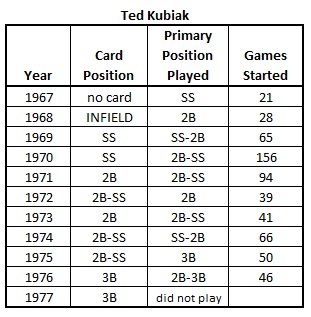
I am most familiar with his 1968 card, which denoted his position as “INFIELD”. So when I saw this 1969 card naming him as a shortstop, I was all ready to rip Topps for promoting him to one position, until I checked into his record today (see chart below).

Kubiak was signed by the Kansas City Athletics in 1961 and made his major-league debut in April 1967. Early in his career he was mostly a fill-in at 2nd base and shortstop.

Why did the Topps airbrushers use BLACK on many of the Athletics' caps in 1968 and 1969? Was green not available?

In December 1969 he was traded to the Brewers for pitcher Diego Segui and shortstop Ray Oyler.

1970 was Ted’s only year as a full-season regular. He started 156 games, playing almost every game at shortstop until moving over to 2nd base in mid-June.

Kubiak also started 77 of the first 104 games in 1971. Beginning at 2nd base, he moved back over to shortstop in early June. By the end of July he was traded to the Cardinals in a 5-player deal that saw Jose Cardenal and Dick Schofield head to Milwaukee.

Ted finished up the season with St Louis but was traded to the Rangers in November for pitcher Joe Grzenda. By mid-season in 1972 he was heading back to Oakland. As he bounced from team-to-team, he never again saw the regular playing time he had in 1970 and early 1971.

His final move was in May 1975, dealt to the Padres for pitcher Sonny Siebert. Ted was primarily a 3rd baseman with San Diego, a position he had rarely played previously. He played every day for his first month with the Padres, then returned to a utility role until retiring following the 1976 season.


Except for the transition from 1968 season to 1969 card, Topps was pretty accurate with the positions on Kubiak’s cards:
Monday, May 27, 2019

Final Card: Ramon Webster

This is Ramon Webster's 3rd and final Topps baseball card (#618). He did not have as much playing time with the Athletics as I had expected before writing this.

Ramon was signed by the Kansas City Athletics in 1963. After 4 seasons in the minors he made his major-league debut in April 1967.

There were no Athletics' first basemen included in the 1967 Topps set, except for the two featured on Athletics' Rookies Stars cards (Webster and Randy Schwartz). Schwartz had cups of coffee in September 1965 and 1966, but was never heard from again. Webster had no prior major-league experience until appearing in April 1967.


The Athletics began the '67 season with Webster alternating at first base with Danny Cater. In June they reacquired Ken Harrelson (who was their 1st-sacker for much of 1965-66) from the Senators. When manager Al Dark was canned in late-August, Harrelson soon followed, and Webster had the position to himself for the rest of the season.

Ramon started 49 games in the first half of 1968, but played the 2nd half of the season in triple-A, only returning to Oakland in September.

He faded further in 1969, only starting 9 games while most of his 64 games were pinch-hitting appearances. He also played in the minors for most of May.

During Spring Training in 1970 he was traded to the Padres for shortstop Roberto Pena. After playing 95 games for the Padres in 1970, bizarre things started happening. He was sold back to the Athletics in October 1970, only to be repurchased by San Diego in April 1971, who then returned him to Oakland 3 weeks later.

The following month he was acquired by the Cubs, and played in 16 games (all but 1 as a pinch-hitter), the last coming on 8/21/71.

Webster played for the Athletics' AAA team from 1972-75, and in Mexico during 1976. After not playing for 2 years, he played briefly for Panama in the Inter-American League in 1979.

Saturday, May 19, 2018

Dick Green (#515)

Dick Green was the Athletics’ starting 2nd baseman from 1964 to 1974. He played for 12 years – all for the Athletics. I really like these 1969 Athletics’ cards – quite a change from the 1968 models! 

Green was signed by the Kansas City Athletics before the 1960 season, and played 4 years in their farm system. In 1960 he played shortstop for the Sanford (FL) Greyhounds in the class-D Florida State League. For the next 2 seasons he was primarily a third baseman.

In 1963 he switched to 2nd base while playing a full season in AAA ball, followed by a September call-up to Kansas City. He played a few games for the A’s at SS and 2B in the closing weeks of 1963.


With the off-season trade of incumbent 2nd baseman Jerry Lumpe to Detroit, Green became the starting 2nd baseman from Opening Day 1964, and would hold that job through the end of the 1974 season, except for a time during 1967-68.

Dick began the 1967 season as the starter, but by mid-June rookie John Donaldson had taken over the starting job. Green rode the bench for a while, but then started most games at 3rd base in July and August. Once rosters were expanded in September, he lost that job to rookie call-up Sal Bando.

With Donaldson still entrenched at 2B in 1968, Green was used mostly as a pinch-hitter for the first half of the season (while also missing the entire month of June), but then regained his old 2nd base job in early August.

After playing in only 76 games in 1968, it was smooth sailing for Green for the next 3 years, playing more than 130 games in each season while nailing down the 2nd base job.

1972 was the low point of Dick’s career. He started the first 7 games of the season, then was out with injuries until mid-August. The Athletics filled in with Larry Brown, Tim Cullen, Dal Maxvill, and Ted Kubiak during that time. Green only started 15 of the 50 remaining games after his return, with Maxvill making most of the starts by then.

Dick regained a starting job for the 1973 season, but 1974 was a different story. He started 95 games at 2B in ’74 (50 more than the next guy), but most of them were in June to August.

Rookie Phil Garner would be taking over the 2nd base job in 1975, so Green was released in early-March, ending his 12-year career.

Green played 36 post-season games for the Athletics from 1971-74, but hit a composite .155.

I remember for a few games in the early 70’s, when the Athletics were the visiting team, their starting lineup would consist of the 8 other players, and another good hitter in the lineup, nominally as the "2nd baseman". This batter (a DH-type, I think maybe Gonzalo Marquez) would bat in the top of the 1st inning, then when the A’s took the field in the bottom of the first, Green would enter the lineup as the 2nd baseman. The whole scheme was to get the light-hitting Green one less at-bat per game.

Saturday, January 20, 2018

First Look - Oakland Athletics

Here's the last in a 5-part series where we get the first look at a new team's uniforms.

Not an expansion team this time, but the recently-relocated Athletics. They moved from Kansas City after the 1967 season, but it took Topps 1 1/2 years to catch up with new player photos.

Included below are the rookie cards for Reggie Jackson, Joe Rudi, and Ed Sprague.


The multi-player card shown above was also posted to this 1969 blog in August 2009 by the blog's previous owner. That is the first blog post I found (not even realizing that Google Blogger existed at that time). A few days later I created an account, and here we are 7+ years later!

Saturday, December 3, 2016

Mike Hershberger (#655)

Mike Hershberger was a starting outfielder for the White Sox and Athletics through most of the 1960s. On Opening Day 1968, Mike lost his starting job to Reggie Jackson, and would be a backup for his final 4 seasons.

Hershberger was signed by the White Sox in 1959, and after 3 seasons in the minors was called up to the Sox in September 1961.

In 1962 Mike started 106 games as a rookie, mostly in right field. He shared the starting job there with Floyd Robinson, who was the starter in 1961. (Robinson played mostly left field in ’62, replacing the departed Minnie Minoso.)


In ’63 and ‘64 he was one of the Sox’ top 3 outfielders in terms of starts and playing time, but since he split his time between center and right fields, Baseball-Reference.com shows him as a non-starter.

In January 1965 he was traded to Kansas city in a 3-team, 8-player trade, and was the Athletics’ starting right fielder for the next 3 seasons, rarely playing the other 2 spots in those years.

Reggie Jackson joined the Athletics during the 1967 season, and was installed as the starting right fielder at the start of the 1968 season, relegating Hershberger to spot-start duty for a few dozen games in right and left field.

With Rick Monday and Jackson established in center and right fields, and Rule 5 pickup Tommie Reynolds starting half the games in left field, there was even less playing time for Mike in 1969 than in the previous year.

The following January he was traded to the Brewers (with pitchers Lew Krausse and Ken Sanders, and catcher Phil Roof) for 1st baseman Don Mincher and infielder Ron Clark. Mike lasted only 1 season in Milwaukee, filling the dubious role of 7th outfielder.

He was released after the 1970 season, and hooked on with the White Sox for 1971. He played more in his final season than he had since 1968, starting 25% of the games in center field behind Jay Johnstone.

Hershberger passed away in 2012 at age 72.

Thursday, June 5, 2014

Final Card: Joe Nossek

I’ve got 21 more “Final Cards” to post in the 1969 set, but haven’t done any since last October, so I’m going to squeeze one in here before I start down the path of featuring the Topps All-Rookie Team. Joe Nossek is the only one of the remaining 21 cards to have played more than 5 seasons in the majors. He finished up with 6 years of service time. 


Joe Nossek (#143) was a member of the 1961 College All-American team, along with catcher Bill Freehan, pitcher Bill Faul, and future Twins’ teammate, shortstop Frank Quilici.

Joe was signed by the Minnesota Twins in 1961 and played 4 seasons in their minor-league organization. He made his major-league debut in April 1964, playing in 7 games at the start of the season (mostly as a pinch-runner) before returning to the minors in early May.


Joe returned to the majors on a full-time basis at the start of the 1965 season. He played in 87 games during his rookie season, mostly as a pinch-hitter and backup center fielder (to Jimmie Hall). Joe also made a few starts at 3rd base. Nossek appeared in 6 games in the 1965 World Series, and was the starting center fielder for games 2, 3, 5, 6, and 7 against the Dodgers’ southpaw starters. He went 4-for-20 (.200).

In mid-May 1966, Joe was sold to the Kansas City Athletics. He played in 87 games for the Athletics in both 1966 and 1967, sharing the starting center field job in 1966 with Roger Repoz and Jim Gosger, then caddying for rookie Rick Monday in 1967.

Nossek spent all of 1968 with Oakland’s AAA team in Vancouver, and was left out of the Topps set in 1968. It's surprising that he was back on Topps' radar in 1969. This is a low-numbered card, and he didn't see any playing time in the previous season.

He began the 1969 season with the A’s, but after 13 games (2 starts), he was sent down to the minors in mid-May, then traded to the Cardinals two months later for utility infielder Bob Johnson. The Cardinals called Joe up at the end of July, where he made 9 pinch-hitting or pinch-running appearances over the rest of the season.

It was back to the minors for almost all of 1970, with only one pinch-hitting appearance for the Cardinals in mid-September. It would be his last major-league game.

In February 1971 Joe was sold to the Brewers, but spent the year in triple-A before retiring.

After his playing career, Nossek was a coach for 28 seasons between 1973 and 2003, for the Brewers, Twins, Indians, Royals, and White Sox.

Monday, August 24, 2009

#556 A's Stars

The first thing that comes to mind when I look at this card is, why did Topps choose these 3 for this card? With my limited knowledge of A's stars and 1969 baseball, I would have gone with Reggie Jackson, Catfish Hunter, Vida Blue and Rollie Fingers. But, looking back at the timeline in all these player's careers helped me see better, for myself, the answer to my question.

Sal was the up-and-comer who had established himself well the year before and really hit his stride in 1969. He was selected to his first All-Star Game, hit 31 home runs and batted .281. Bert was an obvious choice. He was just scary on the base path, swiping 62 that year. His previous year he led the majors with another 62 steals, was 11th in MVP voting and was selected to his first All-Star Game. Danny finished 2nd to Yaz in the AL batting titled in 1968, "The Year of the Pitcher", hitting .290 to Yaz's .301.

As for Reggie, Vida and Rollie, they were all still fresh outta the minors from Iowa and Vancouver! And along with Catfish, they would go on to become legends a little later winning 3 championships in a row for Oakland.


I picked up this card on eBay last week for 25 cents, along with 5 more commons all for a quarter or two each. This was the first time I had seen the team stars format for this set, since I mostly only have lower numbered cards. I really love this card and can't wait to find more like it for the other teams!

Tuesday, March 17, 2009

#260 Reggie Jackson

Here we have Mr. October's rookie card. Lucky for me this one is already in my collection, so I don't have to go out and buy one. It's a little beat up and there's a stain in the top right corner, but I'm happy to have it!

When I was a kid, my Dad sent me into a couple of card shops around Portland to try and sell these cards, including this one. My Dad was thinking he could get half of top book value for this card or, about $150, and of course, the most we were offered was something like $30. I think we even tried selling it on eBay with a ridiculous reserve and didn't get any bids. Ha! Now we know better about real card values.

Reggie's 1969 season was explosive and arguably his best regular season of his career. He set career high marks in many areas including 123 runs, 47 home runs, 118 RBI's, 115 BB's and a .608 SLG percentage! He was ahead of Roger Maris' home run record pace for a bit and the press even started claiming he was dating a lady named "Ruth Maris". In the end he ended up getting beat out for the year by the Twins' Harmon Killebrew who had 49. The Twins also beat out the A's that year for a shot at the A.L. pennant. Reggie got voted into his first All Star game and he also got into the top 5 votes for MVP.

Later, in the off season, Reggie bargained for an increase in his salary, but A's owner Charlie Finley threatened to send Reggie back to the minors!