Showing posts with label ...debut: 1963. Show all posts

Sunday, April 26, 2020

Jim Gosger (#482)

This is a late-series 1969 card, showing Jim Gosger in his new Seattle Pilots uniform. (It’s too bad Topps didn’t think ahead, and put all the expansion team players in the later series, so they had time to get good photos of all the players.) 

Gosger was signed by the Red Sox in 1962, and made his big-league debut with the Sox in May 1963. He played in 19 games that season, mostly as a pinch-hitter or pinch-runner, although he made 2 starts in center field in the season’s final week.

Jim was back in the minors for all of 1964 and the first half of 1965. Beginning on July 9th, he made 19 consecutive starts in center field (replacing Lenny Green), then moved over to right field for the 18 of the next 20 games, while Tony Conigliaro was out of the lineup. When Tony C. returned to the lineup on 8/20, Gosger moved back to center field for the final 42 games. All told, he started 79 of the final 81 games after his recall.


For the first two months of the 1966 season he alternated in center field with Green and George Thomas, then was traded to the Athletics (with pitchers Guido Grilli and Ken Sanders) for outfielder Jose Tartabull and pitchers John Wyatt and Rollie Sheldon. That year, left and center fields were a carousel for the Athletics (with only right fielder Mike Hershberger getting regular playing time). Jim split his time between left and center fields, sharing the starts with Joe Nossek, Roger Repoz, Larry Stahl, and Danny Cater.

Hopefully he made the most of that 1966 mish-mash, because Rick Monday joined the squad in 1967, taking over the center field job in game #10 and for several years thereafter. Gosger was the team's 3rd outfielder in terms of innings played, but he was backing up at all three spots (with Cater starting more in left field than Gosger).

His playing time decreased even more in 1968. Reggie Jackson was in his first full season, moving Hershberger over to share left field with rookie Joe Rudi, and sending Gosger to the bench.

Jim was selected by the Seattle Pilots in the October 1968 expansion draft, and was the team's starting center fielder for 10 of the first 14 games. He was soon replaced by Wayne Comer, and by mid-season was sent to the Mets in exchange for Greg Goossen. He spent the rest of the season in triple-A, only returning to the Mets for 10 games in September, and was not on the Mets' post-season roster.

After the 1969 season Gosger was traded to the Giants for pitcher Ray Sadecki and outfielder Dave Marshall, but before playing any games for San Fran, he was acquired by the Expos in late-April 1970.

For 1970 and 1971, Jim played parts of both seasons with the Expos while also spending a lot of time with their AAA team.

After the 1971 season he was traded back to the Mets for 4 minor-league players. He played for the Mets' AAA team from 1972-74, while also appearing in a few dozen games for New York in '73 and '74.

Gosger was released on 10/1/74 (the Mets didn't waste any time!) ending his 10-year career.

Although very much alive, last year the Mets mistakenly included him in a video honoring deceased ex-Mets.

Sunday, May 12, 2019

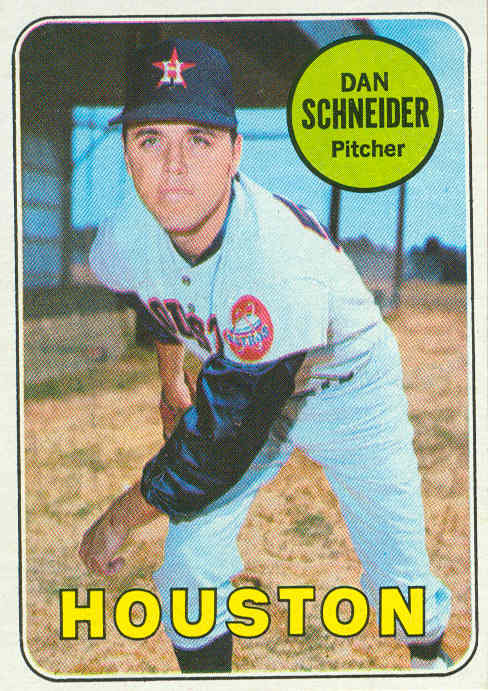
Final Card: Dan Schneider

What's this? The Topps airbrusher missed a spot on this Astros' cap!

No, by late-summer 1969, Topps had resolved their differences with the Astros, or Monsanto, or whomever that caused them to identify the Astros as "Houston" on all the 1968 and 1969 cards, and airbrush the '68 and most '69 cards into oblivion. All the late-1969 cards show the player in their full uniform, but I guess they kept the “Houston” label for continuity.

Not only is this a high-numbered card (#656), but his 1967 card was also in the high-numbered series.

I have been meaning to post Dan Schneider's card for about a year now, but there was always someone else cutting in line for one reason or another.


Schneider was signed by the Milwaukee Braves in June 1962, fresh off being named to the College All-American Team while playing for the University of Arizona. He started his pro career in triple-A, and by the following season was with the Braves, pitching 30 games beginning in mid-May.

He spent most of 1964 in the minors, but did pitch in 13 games for the Braves, mostly in June and September. (He also appeared in a 14th game as a pinch-runner.)

After playing all of 1965 in the minors, Dan found his way back to the Braves (now in Atlanta) for 14 games in June and July 1966. After the '66 season he was traded to the Astros with pitcher Tom Dukes and 2nd baseman Lee Bales for a trio of minor-leaguers.

Dan appeared in 54 games out of the Astros' bullpen in 1967, leading the staff in appearances.

Surprisingly, he spent all of the following season in the minors. Injury rehab? I don't think so – he pitched in 48 games. Oddly enough, he played for the Pirates' AAA Columbus team, and must have been on loan because he was back with the Astros for part of 1969.

Schneider only pitched 6 games for Houston in 1969, the last on April 27th. Sporting a 13.50 ERA by that time, he was quickly sent down to the minors, and at some point was traded to the Cardinals.

He never made it back to the majors after that season, retiring after 1970.

Friday, December 28, 2018

John Boccabella (#466)

John Boccabella played 12 seasons in the big leagues (1963-74). Most of his playing time (376 games) game with the Expos from 1969-73. Earlier, he played 146 games for the Cubs from 1963-68 (with most of that coming in 1966). He finished up his career in 1974 with the Giants.

John was signed by the Cubs in 1963, but played mostly in their farm system from 1963-68. When in the minors, he mostly played 1st base.

1966 was the only season that he spent entirely with the Cubs, and saw action in 75 games. That was also the first year he spent some time behind the plate, both with the Cubs and in the Arizona Fall Instructional League.

He was briefly claimed by the Yankees in the 67/68 off-season, but was returned to the Cubs the following April.


Check out John’s 1968 stats. He played 73 games for the Cubs’ AAA team while only playing 7 games (with 14 at-bats) for the Cubs. Cup of coffee, right? No! He was the Cubs’ #2 catcher that season! How is that possible? Well, Randy Hundley started 156 games that year, collecting 606 plate appearances. Boccabella started 4 games and played 28 innings, while 4 other backstops (Randy Bobb, Gene Oliver, John Felske, and Bill Plummer) split the remaining 40 innings. With all that leisure time in 1968, it’s amazing he even has a card in the 1969 set.

John was selected by the Expos in the October 1968 expansion draft, but so were veteran Astros’ catchers John Bateman and Ron Brand, so Boccabella didn’t really get a fresh start in his new location. Still, John managed to stay out of the minor leagues now that he was with the Expos. He was also a favorite of the PA announcer, who got to say “John Boc-a-BELLLLLLLLLLL-a” many times.

He was the #3 catcher in 1969, then was #2 behind Bateman for the ’70 and ’71 seasons.

Boccabella was the team’s starting catcher for the first 2 months of 1972, then rookie Terry Humphrey took over for 2 months. Tim McCarver (acquired in mid-season from the Phillies for Bateman) handled most of the catching over the final 2 months.

Surprisingly (to me anyway), John was the team’s #1 catcher during the 1973 season, starting 106 games. Humphrey got the odd start during the first half, until he was sent down in mid-season. John was out of the lineup for most of September, but finished up with 10 consecutive starts to close the season.

The Expos’ first-round draft choice Barry Foote was going to be the “catcher of the future”, so Boccabella was dealt to the Giants in April 1974, where he finished his career as a seldom-used backup.


The three "B"s of the 1969 Expos' catching corps:

Saturday, May 19, 2018

Dick Green (#515)

Dick Green was the Athletics’ starting 2nd baseman from 1964 to 1974. He played for 12 years – all for the Athletics. I really like these 1969 Athletics’ cards – quite a change from the 1968 models! 

Green was signed by the Kansas City Athletics before the 1960 season, and played 4 years in their farm system. In 1960 he played shortstop for the Sanford (FL) Greyhounds in the class-D Florida State League. For the next 2 seasons he was primarily a third baseman.

In 1963 he switched to 2nd base while playing a full season in AAA ball, followed by a September call-up to Kansas City. He played a few games for the A’s at SS and 2B in the closing weeks of 1963.


With the off-season trade of incumbent 2nd baseman Jerry Lumpe to Detroit, Green became the starting 2nd baseman from Opening Day 1964, and would hold that job through the end of the 1974 season, except for a time during 1967-68.

Dick began the 1967 season as the starter, but by mid-June rookie John Donaldson had taken over the starting job. Green rode the bench for a while, but then started most games at 3rd base in July and August. Once rosters were expanded in September, he lost that job to rookie call-up Sal Bando.

With Donaldson still entrenched at 2B in 1968, Green was used mostly as a pinch-hitter for the first half of the season (while also missing the entire month of June), but then regained his old 2nd base job in early August.

After playing in only 76 games in 1968, it was smooth sailing for Green for the next 3 years, playing more than 130 games in each season while nailing down the 2nd base job.

1972 was the low point of Dick’s career. He started the first 7 games of the season, then was out with injuries until mid-August. The Athletics filled in with Larry Brown, Tim Cullen, Dal Maxvill, and Ted Kubiak during that time. Green only started 15 of the 50 remaining games after his return, with Maxvill making most of the starts by then.

Dick regained a starting job for the 1973 season, but 1974 was a different story. He started 95 games at 2B in ’74 (50 more than the next guy), but most of them were in June to August.

Rookie Phil Garner would be taking over the 2nd base job in 1975, so Green was released in early-March, ending his 12-year career.

Green played 36 post-season games for the Athletics from 1971-74, but hit a composite .155.

I remember for a few games in the early 70’s, when the Athletics were the visiting team, their starting lineup would consist of the 8 other players, and another good hitter in the lineup, nominally as the "2nd baseman". This batter (a DH-type, I think maybe Gonzalo Marquez) would bat in the top of the 1st inning, then when the A’s took the field in the bottom of the first, Green would enter the lineup as the 2nd baseman. The whole scheme was to get the light-hitting Green one less at-bat per game.

Thursday, December 31, 2015

Ron Brand (#549)

Here is Montreal Expos’ catcher Ron Brand, shown in a late-series card in his brand new Expos uniform. Not only that, but we have an “in-action” shot (rare for 1960s’ cards) that includes his full catching gear. Now THIS is a card!

Brand split the catching duties for the upstart Expos with John Bateman, just like he did for the past few years with the Astros.


Brand was signed by the Pirates in 1958, and labored in the minors for 7 seasons, although he also saw action in 46 games with the Bucs for part of 1964. He mostly played 2B and SS for his first 3 seasons in the minors, then began catching in 1961 (while still playing infield).

After the 1964 season, the Astros selected him in the Rule 5 draft, and he played the next 3 full seasons with the Astros, getting significant playing time in 1965, but was clearly Bateman’s backup in ’66 and ’67.

In 1968, he dropped to 3rd-string behind Bateman and Dave Adlesh, and spent part of the season in triple-A.

1969 brought a change of scenery for him, but unfortunately, Bateman followed him to Montreal. Although Brand caught more games in 1969 than Bateman or the 3rd “B” in the catching corps (John Boccabella), Ron was glued to the Expos’ bench for all of 1970 and 1971, and when he did play, it was usually as the backup shortstop.

He played for the Expos’ AAA team during 1972, then managed class-A teams in the minors from 1974-1976 for 3 different teams (Pirates, Dodgers, Reds). He also played 31 games in 1975 for the Dodgers’ class-A team in Bakersfield.

Also check out Brand's 1968 card.

 ---

Does anyone remember “The King Family Show” from the mid-1960s? About 3 dozen members of this family had a musical variety show on TV for a year or so. The older ladies comprised “The King Sisters”, a popular quartet during the big-band era in the 1940s and 1950s.

Some segments of the show featured them, while other segments featured the teen cousins (pictured below) singing the top pop hits of the day while wearing matching white sweaters with their names (like in the Mickey Mouse Club). There were also segments featuring the smaller children, and the entire family.

Why do I bring this up? Ron Brand is married to the King cousin named Candy (4th from the left below).


The most well-known cousin was Tina Cole (far right). She was on the "My Three Sons" TV show for several years as one of the sons’ wife. Tina, Candy, and 2 of the other girls have toured in recent decades as “The King Cousins”, following in their mothers’ footsteps.

Other King Family trivia:  Liza (tallest one above) is the mother of Arcade Fire musicians Win and Will Butler. The more you know...


Sunday, October 18, 2015

Don Buford (#478)

At age 78 years 8 months, Don Buford is the oldest living player from the 1966-70 era that I have not yet featured on one of my blogs.

He played his first 5 seasons as the White Sox’ 2nd or 3rd baseman, but may be better known for his 5 years as the Orioles’ left fielder during their late-60s/early-70s glory years.


Buford was signed by the ChiSox in November 1959, and played 4 seasons in the minors before making his major-league debut with the Sox in September 1963. He started the final 8 games at 3rd base, replacing Pete Ward, who had started every game at 3rd up to that time.


Don began the 1964 season starting 15 of the first 17 games at 3rd base, then moved over to 2nd base, where he split the job evenly with Al Weis. Both Weis and Buford were switch-hitters, so I don’t know what determined who was starting on a given day.

1965 started out the same as the previous season (splitting 2B with Weis, with a few starts at 3rd base), but Buford was the 2nd baseman for every game from July 17th onward.

Don played 2nd base for the first 2 months of 1966, but in June the White Sox acquired veteran 2nd basemen Jerry Adair and Wayne Causey, moving Buford over to 3rd base for 115 of the final 127 games (including 67 consecutive starts – surprising given how many mix-and-match infielders the Sox had!)

In his final season in Chicago (1967) Don started only 94 games at 3rd, and 39 at 2nd base. The Sox had acquired veteran 3rd-sacker Ken Boyer from the Mets in mid-season, and were also auditioning rookie Dick Kenworthy at the hot corner.

In November 1967, Buford and pitchers Bruce Howard and Roger Nelson were traded to the Orioles for shortstop Luis Aparicio and outfielder Russ Snyder. The O’s already had Brooks Robinson at 3rd base and Dave Johnson at 2nd base, so Buford rode the bench for 2 months in 1968 until finally working his way into the lineup with frequent starts at 2nd base, center field, or left field.

He was the team’s regular left fielder for his final 4 seasons (1969-72). Buford played in the post-season in ’69, ‘70, and ’71, hitting a combined 5 homers with 11 RBI. Although his ALCS batting average was .357, his World Series average was only .207.

After his February 1973 release he played in Japan for 4 years, retiring after the 1976 season.

His son Damon Buford was an outfielder for several teams from 1993-2001.

Wednesday, October 2, 2013

Final Card: Bruce Howard

This is the last of 6 cards for Bruce Howard (#226). Howard had 4 White Sox cards (including 2 Rookie Stars), followed by an Orioles’ card in 1968, then wrapped up with this Senators’ card.

Bruce was signed by the White Sox in 1962, spent 3 seasons as a starting pitcher in the minors, and had September call-ups in both 1963 and 1964.


Howard spent 3 seasons (1965-67) in the Sox’ starting rotation. After two 9-win seasons, he had a 3-10 stinker in 1967, resulting in a trip to the minors, and a post-season trade to Baltimore. The Sox shipped him (with pitcher Roger Nelson and 2B-OF Don Buford) to the Orioles for shortstop Luis Aparicio and outfielder Russ Snyder.

After only 10 appearances, the Orioles flipped him to the Senators for outfielder Fred Valentine in June. Howard fared no better in Washington for the remainder of the season, and played his last major-league game on 9/7/1968.

He played the 1969 season in the minors with the Senators’ and White Sox’ organizations, including some time in the Florida Instructional League, and retired after the season.

His son David was an infielder for the Kansas City Royals in the 1990s.

Sunday, September 30, 2012

Back on Topps' Radar: Billy Cowan

This is Billy Cowan's first card (#643) since the 1965 set. Cowan's career spanned 1963-1972, but he only had 5 cards during that time. Billy appeared as a Cub in the 1964 and 1965 sets, as a Yankee in the 1969 set, and an Angel in the '71 and '72 sets.

A member of the Phillies' organization from 1966 to 1968, he spent most of that time (except for the 2nd half of 1967) in the minors, effectively eliminating his chance for a card in the 1966-1968 Topps' sets.


Cowan was signed by the Cubs in 1961, and spent the next 3 seasons in the minors, finally making his major-league debut on 9/9/63. He made a half-dozen starts, spelling Billy Williams in LF, Lou Brock in RF, and a host of center fielders.

In 1964, Cowan was the Cubs' regular center fielder (I didn't know that until today), starting 127 games between Williams in left and Brock in right (with Len Gabrielson taking over after Brock's trade to St. Louis). Billy hit .241 with 19 home runs, but rarely started during September.

Before the '65 season, he was traded to the Mets for ex-Cub outfielder George Altman. In 1965, Cowan was a frequent center fielder for the Mets, until his early-August trade to the Milwaukee Braves (for infielders Ernie Bowman and Lou Klimchock).

Billy was traded back to the Cubs in late April 1966 for future Yankees' 3rd baseman and Braves' manager Bobby Cox. Two months later he was traded to the Phillies, and spent the rest of '66 with the Phillies' AAA San Diego club.

Cowan began the '67 season in San Diego, but a roster spot with the Phils opened up in late June, after the team sold Dick Groat to the Giants. With 4 of the Phillies' 5 outfielders (Johnny Callison, Tony Gonzalez, John Briggs, Doug Clemens) all batting from the left side, Cowan was called up to provide a right-handed bat off the bench.

In 1968, the Phillies' Richie Allen became the regular left fielder, creating a logjam in the outfield. As such, Cowan spent the entire season back in triple-A.

After the season, the Yankees selected him in the Rule 5 draft, marking the end of Cowan's days in the minor leagues. He split the 1969 season between the Yankees and Angels, and played for the Angels for the '70 and '71 seasons. Primarily used as a pinch-hitter, he was also a backup outfielder and occasional 1st baseman.

Cowan was released by the Angels on May 2nd, 1972, having only played 3 games that season.

Sunday, August 26, 2012

Final Card: Bob Chance

As with my 1966 and 1968 blogs, I'm down to the last half-dozen (+/-) players whose final card is in this set.

Bob Chance (#523) was a 1st baseman for the Indians and Senators in the mid-1960s. After being out of the majors (and Topps' lineup) in 1968, he returned in 1969, playing 5 games with the Angels.

Chance was was signed by the Giants in 1961, and played outfield for their class-D team in El Paso. After the season, he was selected by the Indians in the minor-league draft. Bob played 1st base and outfield for the next 2 seasons with the Tribe's Charleston WV team, which was class A in '62 and double-A in '63. He made his big-league debut on 9/4/63, and started 14 games in right field that month.


He made the jump from AA to the majors at the start of the 1964 season. This was Bob's only full season in the majors, and he made the most of it. After starting most of the games in right field during the month of June, he moved to 1st base and started most of the games there for 2nd half of the season, replacing the incumbent Fred Whitfield.

After the season, Bob and utilityman Woodie Held were traded to the Senators for outfielder Chuck Hinton. Chance spent the next 3 seasons alternating between Washington and the minors (was there a difference?).

In '65, he split the 1st base duties with veteran Joe Cunningham for the 1st half of the season, until he was replaced by Dick Nen, and sent to the minors for July and August. In 1966, Bob was Nen's backup, but after the Senators acquired 1st baseman Ken Harrelson in late June, Chance was back to the minors for the rest of the season.

His 1967 resume with the Senators included only the first month, and then again in September. He spent all of 1968 in the minors, then was selected by the Angels in the Rule 5 draft. Bob's last major-league games was on April 29, 1969. The next day, he was traded to the Braves for catcher Dave Adlesh.

The remainder of the '69 season was split between the Braves' AAA team and the Japanese League. He also played in Japan during 1970.

Wednesday, June 6, 2012

Dick Allen (#350)

This is Dick Allen's final card from his first stint with the Phillies. After winning the NL Rookie of the Year award in 1964, and finishing among the league leaders in homers and RBI several times, Allen wore out his welcome in Philly and was traded after the 1969 season in a 7-player deal that also included Curt Flood and Tim McCarver. After a season each with the Cardinals and Dodgers, Allen had several great seasons with the White Sox before returning to Philadelphia for '75 and '76.

Allen was a high school baseball and basketball star in western Pennsylvania, and was signed by the Phillies in 1960. (The team also signed his brother Hank the same year. Hank would go on to play outfield for the Washington Senators, among others.)

Dick began his minor-league career as a 2nd baseman, and switched to outfield in 1962. After a 2nd full season as an outfielder, he made his major-league debut on September 3rd for the Phillies. Allen played 10 games for the Phillies that season.

Allen moved to 3rd base at the start of 1964, having never played there professionally (except for 1 inning the previous September). He started every game at 3rd in his rookie season, and won the NL Rookie of the Year award. He also led the league in runs, triples, and strikeouts, while hitting 29 homers and collecting 91 RBI. Dick also started 160 games at 3rd base in 1965. Although his home run output dropped to 20, he made his first of 3 consecutive all-star appearances.

1966 started to break up the routine. Allen started 91 games at 3rd base, but (never a great defensive player) also played 47 games in left field. He played 20 fewer games than in 1965, but doubled his home run output with 40 dingers. Dick also led the NL with a .632 slugging percentage. In 1967 he was back exclusively at 3rd, that is, until he sliced up his wrist and missed the last 6 weeks of the season.

Allen returned to full-time status in '68, but this time as the Phillies' left fielder. Only 10 of his 150 games were at his former position. Although he hit 30 homers, his batting average fell to .263, after batting over .300 in his first 4 seasons. He wouldn't finish above .300 until moving to Chicago in 1972.

Because of his defensive liabilities, he moved to 1st base for the 1969 season. That year he also missed a month in mid-season while suspended by the team. Over the years, Allen's relationship with Phillies' management (and fans) deteriorated, and it contributed to the firing of the manager in both 1968 and 1969, and culminated in his trade to the Cardinals after the 1969 season. The Cardinals acquired Allen, 2nd baseman Cookie Rojas, and pitcher Jerry Johnson for relief pitcher Joe Hoerner, catcher Tim McCarver, and outfielders Curt Flood and Byron Browne. Famously, Flood refused to report to the Phillies.

After a stopover in Los Angeles, Allen was traded to the White Sox, where he won the AL MVP award in 1972, while also leading the league in home runs and RBI, and finishing 3rd with a .308 batting average. He also made the all-star team in all three of his seasons with the Sox.

Allen returned to the Phillies midway through the 1975 season, after holding out for several months. In 1976 his bat helped propel them to their first post-season appearance since 1950. Another disagreement with management sent him on his way after the season, this time to Oakland, where he started 50 of the first 61 games at 1st base before the team released him in mid-June.


6/16/2012 EDIT: Here's an excerpt from Allen's Wikipedia page that I just found.  It's a quote from the Philadelphia Inquirer, reviewing a concert that Allen and his musical group had during halftime at a 76ers game in the mid-1960s:

Rich Allen, the most booed man in Philadelphia from April to October, when Eagles coach Joe Kuharich takes over, walked out in front of 9,557 people at the Spectrum last night to sing with his group, The Ebonistics, and a most predictable thing happened. He was booed. Two songs later though, a most unpredictable thing happened. They cheered Rich Allen.

Joe Kuharich - LOL!

Wednesday, December 9, 2009

#389 Dan Coombs


Danny Coombs was a pitcher for the Colt .45s and Astros from 1963 to 1969 and for the Padres from 1970 to 1971. He had a career ERA of 4.08 and a record of 19-27 with 249 strikeouts. He was also a basketball star at Seton Hall measuring at 6 feet 5 inches.


Perhaps one of the most interesting moments in Danny's career was his MLB debut for the Colt. 45s during their sophomore year, two days before the end of the season and desperate for ticket sales. The Colts tried something that had never been done in the major leagues and has not been done since. They fielded the first all-rookie team with an average age of 19. Danny came in at the bottom of the 3rd and gave up 3 singles before closing the inning with a ground-out. For more on this day, follow this link for some great baseball history.

Wednesday, September 30, 2009

#436 Gene Alley

Gene Alley played his entire career for the Bucs from 1963 to 1973, helping beat out the Orioles in 1971 for the championship. Lingering shoulder and knee problems forced him into an early retirement in 1973 at the age of 33. Gene was best known for his 2 time Gold Glove winning fielding abilities, teaming up with Hall of Fame second baseman Bill Mazeroski to create on of the best infield duos ever. The two set a MLB record for 161 double plays in a season in 1966 which still stands, also setting the Pirates up for a NL record with 215 double plays as a team. At one point in 1969 starting on August 13, Gene started a 21 game hitting streak during which he went 30 for 82 (.366) with 8 home runs, 21 RBI and 15 runs scored. He raised his batting average from .218 to .266 after that stretch.

Here's Gene wearing the number 22, not his normal number of 14 which I believe he wore every year except for 1968.