Unlike the last card posted on this blog (Tom Burgmeier) this is an early-season card (#484), which means an airbrushed gem for an expansion team member.
Joe Gordon made his final managerial stop with the 1st-year Kansas City Royals in 1969.
Much earlier, Joe was the Yankees' 2nd baseman from 1938-43, and 1946 (missing 2 years during World War II). Some of his teammates were Lou Gehrig, Joe DiMaggio, and Bill Dickey. (He missed Babe Ruth by 4 years.)
Gordon was a 6-time All-Star, and the 1942 American League MVP.
After the 1946 season he was traded to the Indians for pitcher Allie Reynolds. Joe was their 2nd baseman for the next 4 seasons, and made 3 more trips to the All-Star game. In 1948 he led the Tribe in home runs and RBI (as a 2nd baseman!)
He was released after the 1950 season (odd, being 1-year removed from an All-Star appearance, and having played 119 games in 1950).
---
Gordon was a player-manager for the PCL’s Sacramento team from 1951-52 then scouted for the Tigers for several seasons before returning to manage the Red Sox' San Francisco team in the PCL from 1956-57.
Joe was the Indians' manager from midway through the 1958 season to mid-1960. In August 1960, he was traded to the Tigers for Jimmie Dykes (a manager-for-manager trade!)
Let go after the season, he managed the Kansas City Athletics for the first 59 games of the 1961 season, before owner Charley Finley canned him.
Gordon scouted for the Angels from 1961-68, then managed the expansion Royals for one season, piloting them to 4th place (ahead of the established White Sox and expansion Pilots), then retired after the season at age 54.
He passed away in 1978 at age 63.
Gordon was inducted into the Hall of Fame in 2009.
Showing posts with label ...hall of fame. Show all posts
Monday, August 17, 2020
Tuesday, December 27, 2016
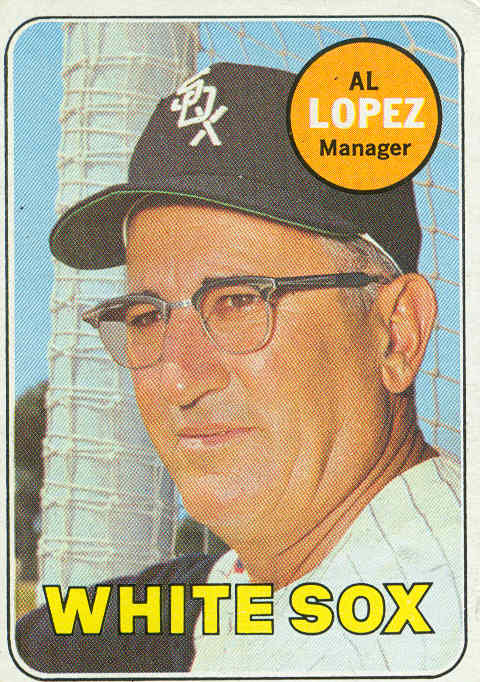
Final Card: Al Lopez
Here is the final card (#527) for White Sox manager Al Lopez. It looks like this photo was taken during the same session as his 1965 card. He also had a card in the 1953 set as the Indians’ manager, and in the 1961 to 1965 sets as the White Sox' manager.
Lopez was a catcher and played in the minors from 1925 to 1929. He had a 3-game cup of coffee with the Brooklyn Dodgers in 1928, before returning to the minors the following season.
Al was the Dodgers' catcher from 1930-35, and made the All-Star team in 1934. He played for the Boston Braves from 1936-40, and the Pirates from 1940-46, although his last 2 seasons with Pittsburgh were as a backup. Al made his 2nd and last All-Star team in 1941.
He played his last big-league season (1947) with the Indians. Retiring after the '47 season, his 1,918 career games caught was a record that stood until Bob Boone broke it 40 years later.
Lopez was a minor-league manager from 1948-50, also serving as his team's backup catcher in 1948.
He managed the Indians from 1951-56, winning the AL pennant in 1954.
Lopez was also the White Sox manager from 1957 to 1965, and won the AL pennant in 1959. His 2 pennants (’54, ’59) were the only times the Yankees DIDN’T win the AL pennant from 1949-64.
After the '65 season he was kicked upstairs to the front office, but returned as field general after Eddie Stanky's firing during the 1968 season.
Soon after that he became ill, forcing him to miss much of the remainder of the '68 season. He returned as manager at the end of the season, managing a total of 47 games in his 2 stints that year. He began the 1969 season as the team's manager, but failing health forced him to retire after 17 games.
Al was inducted into HOF as a manager in 1977.
He passed away in October 2005 at age 97, five days after the White Sox won the World Series (their first championship in 88 years). Lopez was the last living MLB player from the 1920s.
Lopez was a catcher and played in the minors from 1925 to 1929. He had a 3-game cup of coffee with the Brooklyn Dodgers in 1928, before returning to the minors the following season.
Al was the Dodgers' catcher from 1930-35, and made the All-Star team in 1934. He played for the Boston Braves from 1936-40, and the Pirates from 1940-46, although his last 2 seasons with Pittsburgh were as a backup. Al made his 2nd and last All-Star team in 1941.
He played his last big-league season (1947) with the Indians. Retiring after the '47 season, his 1,918 career games caught was a record that stood until Bob Boone broke it 40 years later.
Lopez was a minor-league manager from 1948-50, also serving as his team's backup catcher in 1948.
He managed the Indians from 1951-56, winning the AL pennant in 1954.
Lopez was also the White Sox manager from 1957 to 1965, and won the AL pennant in 1959. His 2 pennants (’54, ’59) were the only times the Yankees DIDN’T win the AL pennant from 1949-64.
After the '65 season he was kicked upstairs to the front office, but returned as field general after Eddie Stanky's firing during the 1968 season.
Soon after that he became ill, forcing him to miss much of the remainder of the '68 season. He returned as manager at the end of the season, managing a total of 47 games in his 2 stints that year. He began the 1969 season as the team's manager, but failing health forced him to retire after 17 games.
Al was inducted into HOF as a manager in 1977.
He passed away in October 2005 at age 97, five days after the White Sox won the World Series (their first championship in 88 years). Lopez was the last living MLB player from the 1920s.
Monday, June 30, 2014
Johnny Bench (#95)
Johnny Bench was the catcher on the Topps 1968 All-Rookie Team, and also the 1968 NL Rookie of the Year. This is Bench’s first solo card. He previously appeared on a Reds Rookie Stars card in the 1968 set.
Bench was selected by the Reds in the 2nd round of the 1965 draft (the inaugural “Rick Monday” draft) with the THIRTY-SIXTH overall pick. He was the EIGHTH catcher selected (behind Ray Fosse, Gene Lamont, Ken Rudolph, and 4 other backstops who never made it to the majors).
Johnny played 3 seasons (1965-67) in the minors, hitting 22 homers in ’66 and another 23 in ’67. He made his big-league debut on August 28, 1967 and started 26 of the Reds’ final 32 games. In the off-season, 6-year incumbent starting catcher Johnny Edwards was traded away to clear a path for Bench, and the rest is history.
Bench made his first of 13 consecutive all-star rosters in 1968, and edged out the Mets’ Jerry Koosman by one vote for NL Rookie of the Year. He also won his first of 10 consecutive Gold Glove awards.
In 1970 and 1972, Bench led the NL in home runs (45, 40) and RBI (148, 125), and won the MVP award both seasons. He also led the NL with 129 RBI in 1974.
Johnny played in the NLCS and World Series in ’70, ’72, ’75, and ’76, and in the NLCS in ’73 and ’79. He grabbed the 1976 World Series MVP award after a .533 batting average and 6 RBI in the ’76.
In 1981, Bench was limited to just 52 games, mostly sharing 1st base with Dan Driessen, and only catching in 7 games. The following season he was the team’s regular 3rd baseman, starting 103 games at the hot corner, while only spending one inning behind the plate.
In his final season (1983), Johnny was a bench player (ha ha!), only starting 41 games at 3rd base, 29 at 1st base, and 3 behind the plate. After a 2-year absence, he made the all-star team in his final season, but it was as a symbolic gesture, as his impending retirement was announced prior to the season.
In 1986, Bench's number 5 was retired by the Reds, and he was inducted into the Reds Hall of Fame. He was elected to the Baseball Hall of Fame in 1989 with 96% of the vote in his first year of eligibility.
Bench was selected by the Reds in the 2nd round of the 1965 draft (the inaugural “Rick Monday” draft) with the THIRTY-SIXTH overall pick. He was the EIGHTH catcher selected (behind Ray Fosse, Gene Lamont, Ken Rudolph, and 4 other backstops who never made it to the majors).
Johnny played 3 seasons (1965-67) in the minors, hitting 22 homers in ’66 and another 23 in ’67. He made his big-league debut on August 28, 1967 and started 26 of the Reds’ final 32 games. In the off-season, 6-year incumbent starting catcher Johnny Edwards was traded away to clear a path for Bench, and the rest is history.
Bench made his first of 13 consecutive all-star rosters in 1968, and edged out the Mets’ Jerry Koosman by one vote for NL Rookie of the Year. He also won his first of 10 consecutive Gold Glove awards.
In 1970 and 1972, Bench led the NL in home runs (45, 40) and RBI (148, 125), and won the MVP award both seasons. He also led the NL with 129 RBI in 1974.
Johnny played in the NLCS and World Series in ’70, ’72, ’75, and ’76, and in the NLCS in ’73 and ’79. He grabbed the 1976 World Series MVP award after a .533 batting average and 6 RBI in the ’76.
In 1981, Bench was limited to just 52 games, mostly sharing 1st base with Dan Driessen, and only catching in 7 games. The following season he was the team’s regular 3rd baseman, starting 103 games at the hot corner, while only spending one inning behind the plate.
In his final season (1983), Johnny was a bench player (ha ha!), only starting 41 games at 3rd base, 29 at 1st base, and 3 behind the plate. After a 2-year absence, he made the all-star team in his final season, but it was as a symbolic gesture, as his impending retirement was announced prior to the season.
In 1986, Bench's number 5 was retired by the Reds, and he was inducted into the Reds Hall of Fame. He was elected to the Baseball Hall of Fame in 1989 with 96% of the vote in his first year of eligibility.
Tuesday, May 13, 2014
Steve Carlton (#255)
Ok, after much delay, I have finally added text to this blog post.
Steve Carlton, who is the greatest Phillies’ left-handed pitcher in their history, began his career with the Cardinals in the mid-1960s.
Carlton was signed by the Cardinals in 1963, and spent only one season in the minors (1964), compiling a 15-6 record, before making his major-league debut with the Cardinals in April 1965.
During his rookie season, he pitched in 11 games prior to the end of June, and then not again until late August, when he pitched 4 times over the season’s last 5 weeks. (I assume he was on the DL in July and August, because he has no minor-league record for 1965.)
Carlton was back in the minors to start the 1966 season, and after compiling a 9-5 record in 19 starts, he rejoined the Cardinals in late July, and pitched 9 games in the final 2 months of the season.
Steve began the 1967 season as the team’s 5th starter, and finished the season with a 14-9 record and an appearance in the World Series.
Carlton pitched for the Cardinals through the 1971 season, bouncing back from a 10-19 record in 1970 to a 20-9 record in 1971.
After the season, he was traded to the Phillies for pitcher Rick Wise. Both pitchers were involved in contract squabbles with their respective teams. (Imagine trading away a 20-game winner!)
Here is Carlton's first card as a Phillie.
Lefty’s first season with the Phillies was one for the record books. He led the NL in all these categories: 27 wins (the Phillies only won 59 games that season!), a 1.97 ERA, 310 strikeouts, 41 starts, 30 complete games, and 346 innings pitched. He also only walked 87 batters (a 310/87 strikeout/walk ratio!) All this earned Carlton his 1st of 4 Cy Young awards.
As if worn out by his 1972 feats, Carlton lost a league-leading 20 games in 1973, although he also led the NL in starts, complete games, and innings pitched. He also struck out 223 batters in ’73.
Lefty pitched for the Phillies until late-June 1986. Along the way, he won 20 or more games 4 times (’76, ’77, ’80, and ’82) winning the Cy Young award in ’77, ’80, and ‘82, and led the NL in strikeouts in ’74, ’80, ’82, and ’83. He was also a combined 6-5 in six post-seasons between 1976 and 1983.
After going 1-8 in 1985, and starting the 1986 season at 4-8, the Phillies released their long-time ace on June 24th. In a classic example of not knowing when to retire, Carlton bounced around for several more seasons with the Giants (July ‘86), White Sox (Aug-Sep ‘86), Indians (Apr-Jul ‘87), and Twins (Aug ’87 – Apr ’88) before retiring.
Carlton finished his career with a 329-244 record, 4136 strikeouts, and a 3.22 ERA. He was inducted into the Hall of Fame in 1994.
Steve Carlton, who is the greatest Phillies’ left-handed pitcher in their history, began his career with the Cardinals in the mid-1960s.
Carlton was signed by the Cardinals in 1963, and spent only one season in the minors (1964), compiling a 15-6 record, before making his major-league debut with the Cardinals in April 1965.
During his rookie season, he pitched in 11 games prior to the end of June, and then not again until late August, when he pitched 4 times over the season’s last 5 weeks. (I assume he was on the DL in July and August, because he has no minor-league record for 1965.)
Carlton was back in the minors to start the 1966 season, and after compiling a 9-5 record in 19 starts, he rejoined the Cardinals in late July, and pitched 9 games in the final 2 months of the season.
Steve began the 1967 season as the team’s 5th starter, and finished the season with a 14-9 record and an appearance in the World Series.
Carlton pitched for the Cardinals through the 1971 season, bouncing back from a 10-19 record in 1970 to a 20-9 record in 1971.
After the season, he was traded to the Phillies for pitcher Rick Wise. Both pitchers were involved in contract squabbles with their respective teams. (Imagine trading away a 20-game winner!)
Here is Carlton's first card as a Phillie.
Lefty’s first season with the Phillies was one for the record books. He led the NL in all these categories: 27 wins (the Phillies only won 59 games that season!), a 1.97 ERA, 310 strikeouts, 41 starts, 30 complete games, and 346 innings pitched. He also only walked 87 batters (a 310/87 strikeout/walk ratio!) All this earned Carlton his 1st of 4 Cy Young awards.
As if worn out by his 1972 feats, Carlton lost a league-leading 20 games in 1973, although he also led the NL in starts, complete games, and innings pitched. He also struck out 223 batters in ’73.
Lefty pitched for the Phillies until late-June 1986. Along the way, he won 20 or more games 4 times (’76, ’77, ’80, and ’82) winning the Cy Young award in ’77, ’80, and ‘82, and led the NL in strikeouts in ’74, ’80, ’82, and ’83. He was also a combined 6-5 in six post-seasons between 1976 and 1983.
After going 1-8 in 1985, and starting the 1986 season at 4-8, the Phillies released their long-time ace on June 24th. In a classic example of not knowing when to retire, Carlton bounced around for several more seasons with the Giants (July ‘86), White Sox (Aug-Sep ‘86), Indians (Apr-Jul ‘87), and Twins (Aug ’87 – Apr ’88) before retiring.
Carlton finished his career with a 329-244 record, 4136 strikeouts, and a 3.22 ERA. He was inducted into the Hall of Fame in 1994.
Tuesday, April 8, 2014
Hank Aaron (#100)
Today is the 40th anniversary of Hank Aaron breaking Babe Ruth's career home run record.
Here we see Hank, fresh off his 1968 season, the year he joined the 500-homer club.
Of Aaron's 755 career homers, 375 were hit in the 1960s, good for 2nd place behind Harmon Killebrew. (You can see the chart of 1960s sluggers in Killebrew's post.)
Hammerin' Hank broke the record on April 8, 1974, during the Braves' first home game of the season. It came in the 4th inning (his 2nd at-bat) off Dodgers' starter Al Downing.
Here we see Hank, fresh off his 1968 season, the year he joined the 500-homer club.
Of Aaron's 755 career homers, 375 were hit in the 1960s, good for 2nd place behind Harmon Killebrew. (You can see the chart of 1960s sluggers in Killebrew's post.)
Hammerin' Hank broke the record on April 8, 1974, during the Braves' first home game of the season. It came in the 4th inning (his 2nd at-bat) off Dodgers' starter Al Downing.
Friday, December 13, 2013
Saturday, October 26, 2013
Ferguson Jenkins (#640)
Ferguson Jenkins was one of the premier starting pitchers of the late-1960s to mid-1970s, winning 20 or more games in his first 6 full seasons with the Cubs (1967-72) and in his first season with the Rangers (1974).
1971 was his best season with the Cubs. He won the NL Cy Young award, and led the NL in wins (24), complete games (30), games started (39), innings pitched (325), but also hits allowed (304) and home runs allowed (29). Fergie also led the league with 273 strikeouts in 1969. He made 3 all-star teams, all with the Cubs.
In 1974 his record with the Rangers was 25-14, and he finished 2nd in the Cy Young voting to the Yankees’ Catfish Hunter, who had the same record. They co-led the AL in wins that season, while Jenkins led the league with 29 complete games, 6 more than Hunter.
All this was a far cry from his beginnings with the Phillies. He was signed in 1962 and made his debut in September 1965, pitching 12 innings in relief over 7 games. After making the Phillies out of spring training in 1966, he didn’t pitch until the 7th game of the season. (Apparently, the geniuses running the Phillies couldn’t fit him into a rotation that included the likes of Ray Herbert and Ray Culp!)
Jenkins’ only game with the Phillies in 1966 was on April 20th, where he pitched the 4th and 5th inning of an 8-1 blowout at the hands of the Braves. He faced 12 batters (striking out 2), but evidently did not impress the Phillies’ brass. The next day he was traded to the Cubs for a pair of veteran pitchers on the downside of their careers. Fergie pitched out of the bullpen for the Cubs until joining the starting rotation on August 25th. After that, the party started!
After 8 seasons with the Cubs, Fergie was traded to the Rangers for infielders Bill Madlock and Vic Harris. He spent 2 seasons with Texas, then pitched for the Red Sox in 1976 and 1977. After the ’77 season, he was traded back to the Rangers for pitcher John Poloni, whose major-league career consisted of TWO GAMES (what the?).
Jenkins won 18 games in 1978 and finished 6th in the Cy Young voting. What a bargain! He remained in the starting rotation for 3 more seasons, although in his last season in Texas (1981) he compiled a 5-8 record (at age 38). Jenkins returned to the Cubs’ starting rotation for his final two seasons, winning 14 and 6 games.
He was released during spring training in 1984, ending his 19-year career. Jenkins was inducted into the Hall of Fame in 1991.
1971 was his best season with the Cubs. He won the NL Cy Young award, and led the NL in wins (24), complete games (30), games started (39), innings pitched (325), but also hits allowed (304) and home runs allowed (29). Fergie also led the league with 273 strikeouts in 1969. He made 3 all-star teams, all with the Cubs.
In 1974 his record with the Rangers was 25-14, and he finished 2nd in the Cy Young voting to the Yankees’ Catfish Hunter, who had the same record. They co-led the AL in wins that season, while Jenkins led the league with 29 complete games, 6 more than Hunter.
All this was a far cry from his beginnings with the Phillies. He was signed in 1962 and made his debut in September 1965, pitching 12 innings in relief over 7 games. After making the Phillies out of spring training in 1966, he didn’t pitch until the 7th game of the season. (Apparently, the geniuses running the Phillies couldn’t fit him into a rotation that included the likes of Ray Herbert and Ray Culp!)
Jenkins’ only game with the Phillies in 1966 was on April 20th, where he pitched the 4th and 5th inning of an 8-1 blowout at the hands of the Braves. He faced 12 batters (striking out 2), but evidently did not impress the Phillies’ brass. The next day he was traded to the Cubs for a pair of veteran pitchers on the downside of their careers. Fergie pitched out of the bullpen for the Cubs until joining the starting rotation on August 25th. After that, the party started!
After 8 seasons with the Cubs, Fergie was traded to the Rangers for infielders Bill Madlock and Vic Harris. He spent 2 seasons with Texas, then pitched for the Red Sox in 1976 and 1977. After the ’77 season, he was traded back to the Rangers for pitcher John Poloni, whose major-league career consisted of TWO GAMES (what the?).
Jenkins won 18 games in 1978 and finished 6th in the Cy Young voting. What a bargain! He remained in the starting rotation for 3 more seasons, although in his last season in Texas (1981) he compiled a 5-8 record (at age 38). Jenkins returned to the Cubs’ starting rotation for his final two seasons, winning 14 and 6 games.
He was released during spring training in 1984, ending his 19-year career. Jenkins was inducted into the Hall of Fame in 1991.
Tuesday, January 1, 2013
Final Card: Mickey Mantle
Starting the new year off in style...
Replacing Billy Martin at the top of this blog is his partner in crime, Mickey Mantle (#500). Mickey and Billy were teammates from 1951 until Martin was traded during the 1957 season. Their off-field exploits are legendary. I like this story particularly.
After 14 straight years as an all-star, Mantle was left off the team in 1966. His numbers actually began to decline in 1965, and would continue to do so for his last 4 seasons.
Mickey switched to first base at the start of the 1967 season, and would play there exclusively for his last 2 seasons, appearing in 131 games each season. He also returned to the all-star game in his final 2 years.
Mantle retired during spring training 1969, with a .298 career batting average, and having played more games than any other Yankee (later surpassed by Derek Jeter).
Having retired before the season, I don't think it was a given that he would get a card that season, and since he was given the "ultimate" card number (#500), we had to wait until well into the season before he appeared on the 5th series checklist (issued in the 4th series). I was thrilled to break open a pack in 1969 and find Mickey Mantle!
Several months after his retirement, the Yankees held Mickey Mantle Day.
Mantle passed away on August 13, 1995 at age 63. I cried that day.
Also check out Mickey on two cards in the 1968 set.
Replacing Billy Martin at the top of this blog is his partner in crime, Mickey Mantle (#500). Mickey and Billy were teammates from 1951 until Martin was traded during the 1957 season. Their off-field exploits are legendary. I like this story particularly.
After 14 straight years as an all-star, Mantle was left off the team in 1966. His numbers actually began to decline in 1965, and would continue to do so for his last 4 seasons.
Mickey switched to first base at the start of the 1967 season, and would play there exclusively for his last 2 seasons, appearing in 131 games each season. He also returned to the all-star game in his final 2 years.
Mantle retired during spring training 1969, with a .298 career batting average, and having played more games than any other Yankee (later surpassed by Derek Jeter).
Having retired before the season, I don't think it was a given that he would get a card that season, and since he was given the "ultimate" card number (#500), we had to wait until well into the season before he appeared on the 5th series checklist (issued in the 4th series). I was thrilled to break open a pack in 1969 and find Mickey Mantle!
Several months after his retirement, the Yankees held Mickey Mantle Day.
Mantle passed away on August 13, 1995 at age 63. I cried that day.
Also check out Mickey on two cards in the 1968 set.
Saturday, January 7, 2012
Ted Williams (#650)
Today we have Ted Williams' rookie card (as a manager). This is the 2nd Senators' manager card in the 1969 set. Jim Lemon's card appeared earlier in the set, but he had been fired before the start of the season, after a 10th place finish in 1968, his only season as a manager. (Topps had also issued 2 manager cards for the Houston Astros in 1966.)


After a long career with the Red Sox (1939-1960), Teddy Ballgame had been out of baseball for several years. (I seem to recall he was a spokesman for fishing gear - maybe for Sears.) In 1969, the Senators came calling, and Williams spent 4 seasons as their manager, including the team's first season as the Texas Rangers. The team finished in 4th, 5th, and 6th during his tenure, an improvement over 1968's 10th-place finish.
Williams is also credited with imparting his hitting knowledge to his players, most notably to perennial weak-hitting shortstop Ed Brinkman. Brinkman routinely batted below the Mendoza line during his career up through 1968. In his 2 seasons under Williams' guidance, he batted above .260. After Ed was traded to the Tigers in 1971, he reverted back to his previous lackluster batting averages for the remainder of his career.
Williams was replaced for 1973 by Whitey Herzog, who didn't make it to the end of the season.


After a long career with the Red Sox (1939-1960), Teddy Ballgame had been out of baseball for several years. (I seem to recall he was a spokesman for fishing gear - maybe for Sears.) In 1969, the Senators came calling, and Williams spent 4 seasons as their manager, including the team's first season as the Texas Rangers. The team finished in 4th, 5th, and 6th during his tenure, an improvement over 1968's 10th-place finish.
Williams is also credited with imparting his hitting knowledge to his players, most notably to perennial weak-hitting shortstop Ed Brinkman. Brinkman routinely batted below the Mendoza line during his career up through 1968. In his 2 seasons under Williams' guidance, he batted above .260. After Ed was traded to the Tigers in 1971, he reverted back to his previous lackluster batting averages for the remainder of his career.
Williams was replaced for 1973 by Whitey Herzog, who didn't make it to the end of the season.
Tuesday, February 23, 2010
Tuesday, September 22, 2009
#419 Rod Carew Sporting News All -Star
Here's a young Sir Rodney on his Sporting News All-Star card #419. Only in his third season, he was on his way to win his first of 7 AL batting titles with an average of .332 that year! This was his 3rd All-Star selection in his, count em', 18 consecutive All-Star selections! He also stole home 9 times that year. Wow.
According to Beckett.com, there were 20 All-Star cards, all with puzzle pieces on the back. The first ten, including this one, featured a Carl Yaztremski puzzle. The other ten featured Pete Rose.This card, along with another dozen, were sent over from Dean at Dean's Cards just because of his love for the 1969 Topps Baseball set! After Dean contacted me, I checked out his store and was really impressed by the sheer volume of singles listed, and the quality of the layout. They've pretty much got the last 100 years of sports trading cards covered, along with a large amount of non-sports cards, mostly from the 1930's through the 1960's. In most cases, you'll have a choice of which grade you want. This card, for instance, shows 5 EX/MT, 15 EX and 4 VG cards in stock! Check 'em out.
Here's the other cards sent over from Dean that will be shown on this blog in the near future:
# 1 AL Batting Leaders -Yaz / Cater / Oliva
# 120 Pete Rose
# 136 Cardinals Rookies - Huntz / Torrez
# 139 Andy Kosco
# 158 Joe Gibbon
# 334 Phil Roof
# 388 Tom McCraw
# 389 Dan Coombs
# 391 Ray Culp
# 436 Gene Alley
# 445 Bobby Knoop
# 553 Ron Davis
Tuesday, March 17, 2009
#260 Reggie Jackson
Here we have Mr. October's rookie card. Lucky for me this one is already in my collection, so I don't have to go out and buy one. It's a little beat up and there's a stain in the top right corner, but I'm happy to have it!When I was a kid, my Dad sent me into a couple of card shops around Portland to try and sell these cards, including this one. My Dad was thinking he could get half of top book value for this card or, about $150, and of course, the most we were offered was something like $30. I think we even tried selling it on eBay with a ridiculous reserve and didn't get any bids. Ha! Now we know better about real card values.
Reggie's 1969 season was explosive and arguably his best regular season of his career. He set career high marks in many areas including 123 runs, 47 home runs, 118 RBI's, 115 BB's and a .608 SLG percentage! He was ahead of Roger Maris' home run record pace for a bit and the press even started claiming he was dating a lady named "Ruth Maris". In the end he ended up getting beat out for the year by the Twins' Harmon Killebrew who had 49. The Twins also beat out the A's that year for a shot at the A.L. pennant. Reggie got voted into his first All Star game and he also got into the top 5 votes for MVP.Later, in the off season, Reggie bargained for an increase in his salary, but A's owner Charlie Finley threatened to send Reggie back to the minors!
Subscribe to:
Posts (Atom)


.jpg)
.jpg)
.jpg)
.jpg)
.jpg)
.jpg)
.jpg)
.jpg)
.jpg)
.jpg)
.jpg)