Showing posts with label ..expansion Royals. Show all posts

Wednesday, November 25, 2020

Final Card: Jon Warden

Jon Warden (#632) only pitched 1 season in the major leagues – for the World Champion Tigers in 1968. 
 
Warden was signed by the Tigers in 1966, and pitched in their farm system for 2 seasons, mostly as a starter. 
 
 
Jon made the Tigers’ squad at the start of the 1968 season, and was converted to a reliever. Until veterans Don McMahon and John Wyatt were acquired in mid-season, the Tigers’ bullpen was mostly rookies and 2nd-year men. 
 
Warden appeared in 28 games for Detroit, posting a 4-1 record. He was with the Tigers for the entire season, save for National Guard assignments. 
 
He only pitched once after August, as the team was battling for the AL title.  With so many relievers (including the veterans), management tried to hide him from the Kansas City and Seattle scouts, fearing he would be lost in the upcoming draft. The Tigers won the World Series, but their stashing of Warden backfired, as he was selected by the Royals in the expansion draft. 
 
An injury during spring training 1969 set him back, and he played all of 1969-70 for the Royals’ AAA team. 
 
Warden moved on to the Brewers' and Cardinals’ organizations in 1971, but never made it back to the majors. Retiring after the 1971 season, he attempted a comeback with the White Sox in 1974 but did not make the team. 
 
Since his playing career he has been a high school teacher and baseball coach, and a frequent attendee at the Tigers’ fantasy baseball camp. 


Monday, August 17, 2020

Final Card: Joe Gordon

Unlike the last card posted on this blog (Tom Burgmeier) this is an early-season card (#484), which means an airbrushed gem for an expansion team member.

Joe Gordon made his final managerial stop with the 1st-year Kansas City Royals in 1969.


Much earlier, Joe was the Yankees' 2nd baseman from 1938-43, and 1946 (missing 2 years during World War II). Some of his teammates were Lou Gehrig, Joe DiMaggio, and Bill Dickey.  (He missed Babe Ruth by 4 years.)

Gordon was a 6-time All-Star, and the 1942 American League MVP.

After the 1946 season he was traded to the Indians for pitcher Allie Reynolds. Joe was their 2nd baseman for the next 4 seasons, and made 3 more trips to the All-Star game. In 1948 he led the Tribe in home runs and RBI (as a 2nd baseman!)

He was released after the 1950 season (odd, being 1-year removed from an All-Star appearance, and having played 119 games in 1950).

---

Gordon was a player-manager for the PCL’s Sacramento team from 1951-52 then scouted for the Tigers for several seasons before returning to manage the Red Sox' San Francisco team in the PCL from 1956-57.

Joe was the Indians' manager from midway through the 1958 season to mid-1960. In August 1960, he was traded to the Tigers for Jimmie Dykes (a manager-for-manager trade!)

Let go after the season, he managed the Kansas City Athletics for the first 59 games of the 1961 season, before owner Charley Finley canned him.

Gordon scouted for the Angels from 1961-68, then managed the expansion Royals for one season, piloting them to 4th place (ahead of the established White Sox and expansion Pilots), then retired after the season at age 54.

He passed away in 1978 at age 63.

Gordon was inducted into the Hall of Fame in 2009.

Friday, July 17, 2020

Tom Burgmeier (#558)

Tom Burgmeier was one of the good, young pitchers selected by the Royals in the expansion draft prior to the 1969 season. I thought he began his career in the Angels' organization, but I learned today that he was signed by the Houston Colt .45s in the Fall of 1961.

After 2 ½ season on the Colts' farm he was released in June 1964, but picked up by the Angels the following month.

Tom made his major-league debut with the Angels in 1968. He did not have any baseball cards as an Angel, because Topps missed the boat on many of their young pitchers from 1966-68. A custom card can be found in this blog post. This late-series 1969 card, featuring the new Royals’ uniform is his rookie card.


Burgmeier pitched in 745 games over his 17-year career, all but 3 in relief. He was a key member of the Royals' bullpen from 1969-72, fashioning a 24-16 record in 190 games over those 4 seasons, with 27 saves. 17 of those saves were in 1971, and he led the 1972 team with 9 saves.

It all came crashing down in 1973. He pitched 6 games in the first month of the season, but spent the remainder of the year in the minors.

After the season he was traded to the Twins for a minor-leaguer. Tom pitched for the Twins from 1974-77, and led the team with 11 saves in 1975.

Granted free agency, he signed with the Red Sox in 1978, and spent the next 5 seasons in Boston. In 1980 he led the team with 24 saves, and was named to his only All-Star team.

He played his final 2 seasons (1983-84) with the Athletics. In 17 seasons, his teams never made it to the playoffs.

Tuesday, December 31, 2019

Joe Keough (#603)

This is Joe Keough’s rookie card. (I was sure he had a card in the 1968 set, but was unable to find one.) Joe is the younger brother of Marty Keough, who played for the Red Sox, Reds and others from 1956-1966.

Joe was drafted by the Kansas City Athletics in the 2nd round of the 1965 draft, right after they selected Rick Monday at #1 (and ahead of Sal Bando and Gene Tenace).   He played for their class A team in 1966 and 1967, then split the 1968 season between Oakland and their AA team.

Look at me – correcting Topps’ mistake with Keough’s bats/throws info back in 1969. 

Keough was drafted by the Royals with the 8th pick in the 1968 expansion draft.

Joe started 12 of the first 14 games in right field in the Royals’ first season, but soon found himself on the bench, and by late-May was back in the minors. He returned to the Royals in mid-July, but was mostly a spare outfielder.

In 1970 he was the 4th outfielder, backing up Lou Piniella and Pat Kelly at the corner spots. He missed the second half of the season due to a broken leg.

Joe was the team’s primary right fielder in 1971, starting 87 games there and another six games in center field.

Richie Scheinblum was acquired in 1972, and took over the right field spot (while also making the All-Star team), pushing Keough all the way down to #6 outfielder.

Joe was traded to the White Sox in February 1973 for outfielder Jim Lyttle, but only appeared in 5 games (with one at-bat) for the Sox. After a full season with Chicago’s AAA team, he was sold to the Twins in October 1973, but retired before 1974.

Keough passed away in September 2019 at age 73.

Saturday, August 31, 2019

Ed Kirkpatrick (#529)

Here is Royals' outfielder Ed Kirkpatrick, in his brand-new KayCee garb that we first saw in the final 2 series of the 1969 Topps set.

Kirkpatrick spent most of the 1960s in the Angels' organization. Signed before the 1962 season, he was primarily a catcher for his first 2 minor-league seasons, before switching over to the outfield in 1964.

Ed made his major-league debut in September 1962, but played most of the '62, '63, and '65 seasons in the minors. He had significant playing time with the Angels during 1964, sharing the left field starting assignments with Willie Smith and Jimmy Piersall.


Kirkpatrick was recalled from the minors in September 1965, and made most of the starts in right field the rest of the way. He stuck with the Angels for all of 1966, becoming the primary right fielder (69 starts) along with a dozen starts in left field.

The acquisitions of Jimmie Hall and Roger Repoz in 1967 made the outfield fairly crowded, so Ed played back in triple-A that season, save for 3 games in July.

Kirkpatrick returned to the Angels for 1968, his last before a pre-season trade in 1969 which sent him to the Royals for pitcher Hoyt Wilhelm.

Freed from the logjam in the Angels' outfield, Ed was a fulltime regular for the Royals from 1969 to 1973. Most of his time from 1970-72 was spent behind the plate, sharing the job with Ellie Rodriguez (’70) and Jerry May (’71), and starting 104 games behind the dish in 1972.

In 1973, Fran Healy and Carl Taylor took over the backstopping, moving Kirkpatrick back to his old right field position, which he divvied up with Hal McRae.

Ed was traded to the Pirates after the 1973 season for pitcher Nelson Briles. He shared the first base duties with Bob Robertson in 1974, but when Willie Stargell moved to 1st base in 1975, Ed spent the next 2 seasons as the 5th or 6th outfielder.

Ed played for the Pirates, Rangers, and Brewers in 1977, then following his March 1978 release, he split the '78 season between the Angels' AAA team and the Mexican league, before retiring.

Kirkpatrick was in a car accident in 1981, and suffered a heart attack during brain surgery. This left him in a coma for several months, and permanently paralyzed. He died in 2010 at age 66.

Saturday, July 13, 2019

The 1969 Royals

The Kansas City Royals entered the league in 1969, two years after the Athletics departed for Oakland. They were the quickest of the 1969 expansion class to find success, starting with their first season!

In their infinite wisdom, the American League put both expansion teams (Royals and Pilots) in the same division, guaranteeing that one of the 4 expansion teams would not finish last. Not only did the Royals not finish last, they outplayed the Chicago White Sox, to finish in 4th place in the 6-team division.

In their first 7 seasons, the Royals finished in 4th place 3 times and in SECOND place 3 times. Beginning in 1976, they finished in FIRST place 3 consecutive years, and in 4 of 5 years.

Contrast that to the Padres, Expos, and Pilots:
Padres: Finished in last place for their first 6 seasons, and no higher than 4th until 1984.
Expos: Finished 6th or 5th (thank you Phillies!) in their first 4 seasons, and no higher than 4th until 1979.
Pilots/Brewers: Finished 6th or 5th in 8 of their first 9 seasons (finishing in 4th place in 1970!), but no higher than 4th until 1978.

The Royals finished with a 69-93 record in their first season. They found a few good players that first year:
Lou Piniella led the team with a .282 batting average, and won the Rookie of the Year award.
Joe Foy improved upon his previous season with the Red Sox, leading the team with 71 RBI.
After 2 bad seasons with the Orioles, Wally Bunker regained his old form (if only for 1 season) and posted 12 wins.

Although this is the 1970 card, the photo is most likely of the '69 team.


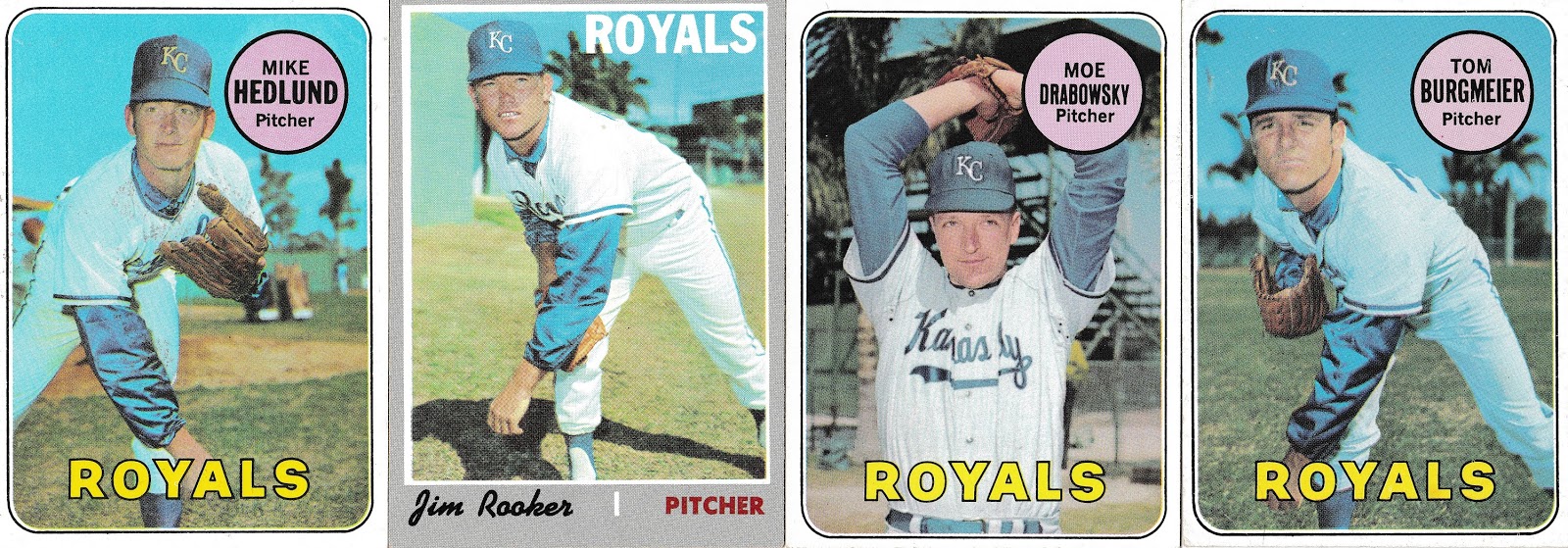
Here is the pitching staff, in order of innings pitched:

Wally Bunker, Dick Drago, Bill Butler, and Roger Nelson were the top 4 starters, each pitching 190+ innings. Bunker and Drago both had double-digit wins, while Butler led the staff with 156 strikeouts. Drago also appeared in 15 games in relief.

Jim Rooker started 22 of his 28 games as the #5 starter. Mike Hedlund was a swingman, pitching 34 games, but making only 16 starts.The remaining hurlers each pitched less than 100 innings, and made no starts (except for 4 by Steve Jones, and 2 each by Dave Morehead and Chris Zachary). Moe Drabowsky was the team’s closer, notching 11 saves. Tom Burgmeier was the top southpaw in the bullpen.

Rounding out the bullpen were Dave Wickersham, Steve Jones (pictured on a Rookie Stars card below), and Dave Morehead. Pitching less than 25 innings were Don O’Riley, Galen Cisco, Chris Zachary, Jerry Cram, and Al Fitzmorris.


The Starting Eight:

Ellie Rodriguez started 83 games behind the plate. Mike Fiore shared the first base job with Chuck Harrison, with Mike getting 88 starts. Jerry Adair started 105 games at 2nd base and another 8 at shortstop. Jackie Hernandez started 139 games at shortstop, the most for any player at one position.

Joe Foy started 107 games at third base. ROY Lou Piniella started 122 games in left field. The other 2 outfield spots were a mix-and-match. Bob Oliver started 44 games in center field and 41 in right. Pat Kelly also started 44 games in center, and 60 in right. Others below also made several dozen starts in the outfield.


The subs, in order of at-bats:
Ed Kirkpatrick was the fourth outfielder, starting between 20 and 30 games at each of the 3 spots. He also caught 8 games. Paul Schaal made 45 starts at 3rd base, mostly in July and August. Chuck Harrison made 50 starts at first base, with 20 of them in May when Fiore was out of the lineup. Rookie Buck Martinez join the team in mid-June, and was the backup catcher until rosters were expanded in September.

Juan Rios was the backup middle infielder, starting 30 games at 2B and 10 at shortstop. Joe Keough started 17 games each in center and right fields, but spent 6 weeks in June and July back in the minors. Hawk Taylor was primarily a pinch-hitter, only starting 2 games behind the plate in mid-April. Topps decided to call him “Bob” on his 1969 card. Jim Campanis was the early-season backup catcher. He played in 26 games (18 starts) through June 1st, then was sent down in favor of Martinez.

Luis Alcaraz spent the season in triple-A, then after his September call-up started 18 of the last 21 games at 2nd base. Fran Healey also played in AAA for the season, then played 6 games (3 starts) in September. Billy Harris also played in triple-A for most of the season, but made 5 pinch-hitting appearances for the Royals – 2 in June and 3 in September. Joe Gordon led this bunch to an unexpected fourth-place finish, then resigned after the season. He had previously managed the Indians, Tigers, and Athletics from 1958-61.


These had Royals cards but did not play for them in 1969:

Dennis Ribant was sold to the Cardinals during spring training. Jon Warden pitched in 28 games for the Tigers in 1968, but never played in the majors after that. He pitched for the Royals’ AAA team in 1969 and their class-A team in 1970.

Dave Nicholson’s last regular major-league action was with the Astros in 1966. He also appeared in 10 games for the Braves during a September 1967 call-up, but spent all of 1968 and 1969 in triple-A. Steve Whitaker was traded to the Pilots in pre-season for Lou Piniella.


Rookie Cards:

Every one of these 15 players appeared for the Royals in 1969. Steve Jones appeared in 16 games (mostly in relief) then was sent down to AAA in mid-June, returning in September. George Spriggs appeared in 23 games in April and September, mostly as a pinch-hitter.

Don O’Riley pitched 18 games in relief, from late-June to late-July, and again in September. Dennis Paepke played in 12 games (7 starts) in June. Fred Rico played in 12 games (9 starts) in September.

Scott Northey was one-and-done in 1969, making 16 starts in center field during his September call-up. Unlike the other six in this last section, Al Fitzmorris had a long career (10 years), starting with 4 games in September.


Transactions from team inception until the end of 1969: 

08/14/68 - Purchased Galen Cisco from the Red Sox.
09/08/68 - Purchased Orlando Pena from the Pilots.

10/15/68 expansion draft:
From the Red Sox: Joe Foy, Dave Morehead, Jerry Adair
From the Yankees: Jim Rooker, Ellie Rodriguez, Steve Whitaker
From the Orioles: Roger Nelson, Mike Fiore, Wally Bunker, Moe Drabowsky
From the Senators: Steve Jones, Ike Brookens
From the Indians: Billy Harris, Mike Hedlund, Fran Healy
From the Tigers: Jon Warden, Bill Butler, Dick Drago
From the White Sox: Al Fitzmorris, Hoyt Wilhelm, Scott Northey
From the Twins: Bob Oliver, Pat Kelly, Jackie Hernandez, Jerry Cram
From the Athletics: Joe Keough, Don O’Riley
From the Angels: Paul Schaal, Tom Burgmeier


10/16/68 - Purchased George Spriggs from the Pirates.

10/18/68 - Purchased John Gelnar from the Pirates.
10/18/68 - Purchased Chuck Harrison and Dave Nicholson from the Braves.

10/21/68 - Purchased Luis Alcaraz from the Dodgers.
10/21/68 - Purchased Dave Wickersham from the Pirates.
10/21/68 - Purchased Chris Zachary from the Astros.

12/02/68 - Drafted Fred Rico from the Orioles in the rule 5 draft.
12/02/68 - Drafted Hawk Taylor from the Angels in the rule 5 draft.
12/02/68 - Drafted Rich Severson from the White Sox in the minor league draft.

12/12/68 - Traded Hoyt Wilhelm to the Angels for Ed Kirkpatrick and Dennis Paepke.

12/15/68 - Acquired Jim Campanis from the Dodgers.
12/15/68 - Purchased Dennis Ribant from the Tigers.

12/16/68 - Acquired Buck Martinez from the Astros.

03/25/69 - Purchased Juan Rios from the Expos.

03/29/69 - Sold Dennis Ribant to the Cardinals.

04/01/69 - Traded John Gelnar and Steve Whitaker to the Pilots for Lou Piniella.
04/01/69 - Acquired Bill Kelso from the Reds.

06/05/69 - Traded Bill Kelso to the Twins.

08/12/69 - Purchased Billy Sorrell from the Mets.

10/21/69 - Traded Dave Wickersham to the Braves for Ron Tompkins.

12/01/69 - Drafted Ken Wright from the Red Sox in the rule 5 draft.
12/01/69 - Drafted Aurelio Monteagudo from the Cardinals in the minor league draft.

12/03/69 - Traded Joe Foy to the Mets for Bob Johnson and Amos Otis.

Sunday, December 2, 2018

Final Card: Luis Alcaraz

This makes 2 consecutive Royals, which I usually try to stay away from. But I’m wrapping up the remaining "final cards" in the 1969 set and over the next 20 cards to be posted, 6 are Royals, so buckle-up.

I always thought that the early Royals' uniforms looked a lot like the Dodgers' uniforms, with a similar shade of blue and the script lettering on the front. In this case, Alcaraz IS wearing a Dodgers' uniform.


Luis Alcaraz (#437) was signed by the Milwaukee Braves in 1959, and a year later was traded to the Dodgers' organization. Luis spent 10 years in the minors, never advancing above class A during his first 8 seasons. In 1967 and 1968 he played in AA and AAA ball respectively, while also playing a few games with the Dodgers in those 2 seasons.

He made his major-league debut on September 13, 1967, starting 17 of the final 18 games at 2nd base. That late-season tryout earned him a roster spot to start the 1968 season, but although he started 27 of the first 37 games at either 2B or 3B, by June he rarely played, and was back in the minors until September.

Purchased by the Royals a week after the expansion draft, he appeared briefly with KC over the next 2 seasons, but spent most of his time with their AAA team in Omaha.

He never played in the majors again after 1970, but during Spring Training 1971 he was traded to the White Sox for veteran 2nd baseman Bobby Knoop.

He subsequently played in the Braves' and Pirates' organizations in 1972, and played in Mexico from 1973-1981, finally retiring at age 40.

Sunday, November 11, 2018

Final Card: Chuck Harrison

After being left out of the 1968 card set, Chuck Harrison returned for one last card (#116) – this time as a member of the expansion Kansas City Royals.

Harrison was signed by the Houston Colt .45s in 1963, and made his major-league debut with 12 games in September 1965.

He was the Astros' regular 1st baseman in 1966, playing in 119 games, but 9 home runs and 52 RBI aren't very much for a corner infielder.

After starting 113 games in '66, he spent much of the 1967 season on the bench, only starting 44 games, with newly-acquired Eddie Mathews replacing him at 1st base.


In October 1967 Chuck was included in the trade that sent Sonny Jackson to the Braves in return for pitcher Denver Lemaster and shortstop Denis Menke.

Harrison spent the entire 1968 season playing at triple-A Richmond. Three days after the expansion draft, the Royals purchased both Harrison and Dave Nicholson (also missing from the 1968 Topps set) from the Braves.

Chuck was with the Royals for all of 1969, but only played 75 games, as the team went with ex-Orioles prospect Mike Fiore as their first baseman.

Harrison spent all of 1970 and the first half of 1971 in the minors, before returning to KayCee in June 1971 to play his final 49 major-league games.

He hung up his spikes after playing for the Rangers’ AAA Denver team in 1972.

Monday, October 2, 2017

First Look - Kansas City Royals

Here's the first in a 5-part series where we get the first look at a new team's uniforms.

Four teams were added in the 1969 expansion, and although the players for these teams appeared capless or airbrushed in the early series, by mid-summer we started to see players in their new uniforms.

First up - the Kansas City Royals

The Royals had more (non-rookie-stars) player cards in their new uniforms than any of the other expansion teams.

Only one of the Rookie Stars cards was issued late enough to include players in the new uniforms.

(Wow, the "windbreaker look" is in high gear!)