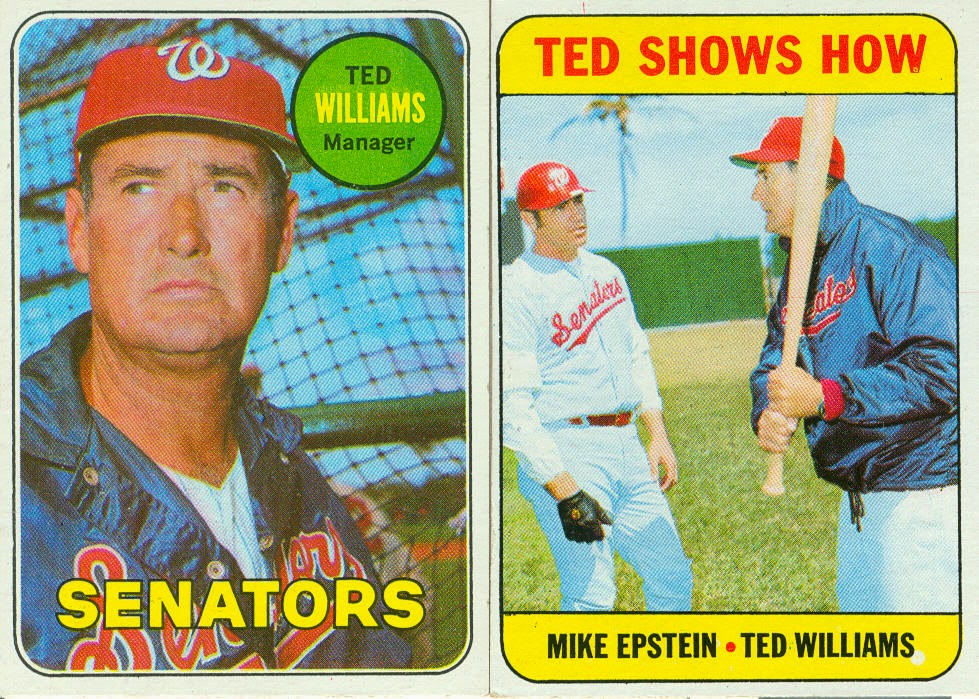
So, Robert over at the $30 a Week Habit blog has been running a 16-set tournament, where bloggers vote for which set he should complete next. The 1969 set is now in the quarterfinals, facing off against the 1974 set. I vote for the 1969 set (surprise!), because:
The first cards for the 4 new expansion teams. Players are airbrushed in the early series, but shown in their new uniforms in the later series (Oakland A’s too!)
Passing the Torch:
The first Topps cards of Ted Williams since 1958:
45 future Hall-of-Famers are in the set, including Willie Mays, Mickey Mantle, Don Drysdale, Roberto Clemente, Ernie Banks, and Bill Mazeroski, none of who are in the 1974 set.
Key players for the Miracle Mets in the 1969 World Series:
Also, the final card for 40 players are in the 1969 set, including Mickey Mantle, Don Drysdale, Johnny Podres, Elroy Face, Ken Boyer, and Bill White.
Vote early (and often)!
Showing posts with label Ted Williams. Show all posts
Saturday, August 9, 2014
Monday, March 10, 2014
Ted Shows How (#539)
Here's one of the four multi-player cards in the 1969 set. There is also a multi-player card for the Athletics in this set, which the previous owner of this blog posted in August 2009. I stumbled upon it a month later, which was my introduction to Google Blogger. A few days later, I started my 1967 and 1968 blogs.
Here, the Senators' manager Ted Williams apparently is showing young first baseman Mike Epstein the value of choking up on the bat. Epstein came over to the Senators early in the 1967 season from the Orioles, where he was blocked by Boog Powell.
Epstein played 2 seasons with the Nats before Williams' tenure as manager. During their first 2 seasons together, Epstein's stats improved greatly.
Perhaps the best example of Williams' influence on a player's batting was perennial light-weight Ed Brinkman. Prior to Ted's arrival in 1969, Brinkman struggled to reach the Mendoza Line. In fact, in 3 of the 4 seasons prior to 1969, Ed hit in the .180's. In the two seasons under Williams' tutelage, Brinkman's batting average soared to .268 and .262.
He was traded to the Tigers after the 1970 season, where his average plummeted 40 to 60 points below his 1969 high in each of the next 4 seasons.
Here is a post on my 1966 blog, listing all the multi-player cards in the 1966 to 1969 sets.
Here, the Senators' manager Ted Williams apparently is showing young first baseman Mike Epstein the value of choking up on the bat. Epstein came over to the Senators early in the 1967 season from the Orioles, where he was blocked by Boog Powell.
Epstein played 2 seasons with the Nats before Williams' tenure as manager. During their first 2 seasons together, Epstein's stats improved greatly.
Perhaps the best example of Williams' influence on a player's batting was perennial light-weight Ed Brinkman. Prior to Ted's arrival in 1969, Brinkman struggled to reach the Mendoza Line. In fact, in 3 of the 4 seasons prior to 1969, Ed hit in the .180's. In the two seasons under Williams' tutelage, Brinkman's batting average soared to .268 and .262.
He was traded to the Tigers after the 1970 season, where his average plummeted 40 to 60 points below his 1969 high in each of the next 4 seasons.
Here is a post on my 1966 blog, listing all the multi-player cards in the 1966 to 1969 sets.
Saturday, January 7, 2012
Ted Williams (#650)
Today we have Ted Williams' rookie card (as a manager). This is the 2nd Senators' manager card in the 1969 set. Jim Lemon's card appeared earlier in the set, but he had been fired before the start of the season, after a 10th place finish in 1968, his only season as a manager. (Topps had also issued 2 manager cards for the Houston Astros in 1966.)


After a long career with the Red Sox (1939-1960), Teddy Ballgame had been out of baseball for several years. (I seem to recall he was a spokesman for fishing gear - maybe for Sears.) In 1969, the Senators came calling, and Williams spent 4 seasons as their manager, including the team's first season as the Texas Rangers. The team finished in 4th, 5th, and 6th during his tenure, an improvement over 1968's 10th-place finish.
Williams is also credited with imparting his hitting knowledge to his players, most notably to perennial weak-hitting shortstop Ed Brinkman. Brinkman routinely batted below the Mendoza line during his career up through 1968. In his 2 seasons under Williams' guidance, he batted above .260. After Ed was traded to the Tigers in 1971, he reverted back to his previous lackluster batting averages for the remainder of his career.
Williams was replaced for 1973 by Whitey Herzog, who didn't make it to the end of the season.


After a long career with the Red Sox (1939-1960), Teddy Ballgame had been out of baseball for several years. (I seem to recall he was a spokesman for fishing gear - maybe for Sears.) In 1969, the Senators came calling, and Williams spent 4 seasons as their manager, including the team's first season as the Texas Rangers. The team finished in 4th, 5th, and 6th during his tenure, an improvement over 1968's 10th-place finish.
Williams is also credited with imparting his hitting knowledge to his players, most notably to perennial weak-hitting shortstop Ed Brinkman. Brinkman routinely batted below the Mendoza line during his career up through 1968. In his 2 seasons under Williams' guidance, he batted above .260. After Ed was traded to the Tigers in 1971, he reverted back to his previous lackluster batting averages for the remainder of his career.
Williams was replaced for 1973 by Whitey Herzog, who didn't make it to the end of the season.
Subscribe to:
Posts (Atom)


.jpg)
.jpg)