Here is the final card for pitcher Dennis Ribant (#463). This is the second Royals card posted to this blog, but the first one showing the new Royals' uniform (although Ribant never played for the team).
For most of the 1969 season, collectors were presented with a large number of capless or airbrushed cards, not only for the usual load of traded players, but because of the four expansion teams, as well as the recently relocated Oakland Athletics. By mid-season, we were rewarded with beautiful photos of players on the 4 new expansion teams, plus the Oakland A's.
Dennis Ribant was signed by the Braves in 1961, and was a combined 21-4 in his first season (17-4 in class D, 4-2 in double-A). He pitched 3 more seasons in the Braves' system, then was traded to the Mets on August 8, 1964.
Dennis made his major-league debut with the Mets on the next day, and made 14 appearances (7 starts) for the remainder of the season. Ribant split the 1965 season between the Mets' bullpen and triple-A, then had a good season in 1966, winning 11 games for the hapless Mets.
After the '66 season, Ribant was traded to the Pirates for pitcher Don Cardwell. In November 1967, it was on Detroit for pitcher Dave Wickersham. The Tigers traded him to the White Sox in July 1968, then re-acquired him after the season (causing him to miss out on the 1968 World Series).
The expansion Royals purchased his contract in December 1968, but by the end of spring training in 1969, he moved on to the Cardinals. Ribant spent most of 1969 in the minors, first in the Cards' organization, then with the Reds after a mid-season trade. His final major-league games was on September 27th.
Ribant pitched in the minors from 1970-73, with the Pirates, Padres, and Phillies.
Also check out Ribant's 1967 card.
I thought I only had one more "final card" after this one (Mickey Mantle), but I found another 40 while going through my 1969 binder recently, including 17-year veteran Ron Kline.
Saturday, October 27, 2012
Sunday, October 21, 2012
1968 World Series
Here are the cards highlighting the 1968 World Series (coincidentally won by the Detroit Tigers). After a 4-game sweep in the '66 series, the Fall Classic went the distance for the next 2 seasons.
Several of the story lines during that time were:
1) Tigers' manager Mayo Smith putting centerfielder Mickey Stanley at shortstop, having never played there prior to late September. This kept weak-hitting Ray Oyler OUT of the lineup, while keeping outfielders Willie Horton, Jim Northrup, Al Kaline, and Stanley all IN the lineup.
2) Bob Gibson and his non-existent ERA leading the charge in the Year of the Pitcher.
3) The Tigers' Denny McLain becoming the first 30-game winner in decades.
The key for me was Smith's handling of his starting pitchers. With the 3-man post-season rotation back then, Gibson and McLain started games 1 and 4, with Gibson winning both. Detroit's #2 starter Mickey Lolich won games 2 and 5 against lesser Cardinals' pitching.
Instead of having McLain face Gibson in game 7, Smith brought McLain back on short rest for game 6, where he finally picked up a win against a lesser Cardinals pitcher, as the Tigers blew out the Cardinals by a 13-1 score.
This positioned Lolich for a game 7 match-up with Gibson, which paid off for the Tigers.
Several of the story lines during that time were:
1) Tigers' manager Mayo Smith putting centerfielder Mickey Stanley at shortstop, having never played there prior to late September. This kept weak-hitting Ray Oyler OUT of the lineup, while keeping outfielders Willie Horton, Jim Northrup, Al Kaline, and Stanley all IN the lineup.
2) Bob Gibson and his non-existent ERA leading the charge in the Year of the Pitcher.
3) The Tigers' Denny McLain becoming the first 30-game winner in decades.
The key for me was Smith's handling of his starting pitchers. With the 3-man post-season rotation back then, Gibson and McLain started games 1 and 4, with Gibson winning both. Detroit's #2 starter Mickey Lolich won games 2 and 5 against lesser Cardinals' pitching.
Instead of having McLain face Gibson in game 7, Smith brought McLain back on short rest for game 6, where he finally picked up a win against a lesser Cardinals pitcher, as the Tigers blew out the Cardinals by a 13-1 score.
This positioned Lolich for a game 7 match-up with Gibson, which paid off for the Tigers.
Tuesday, October 16, 2012
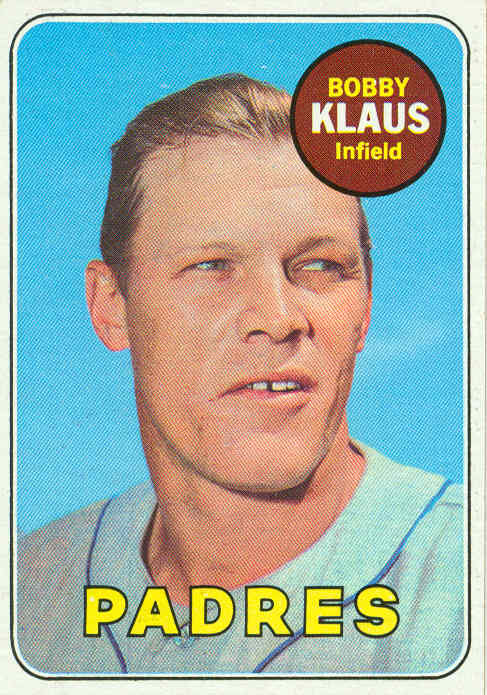
Final Card: Bobby Klaus
This is the final card for Bobby Klaus (#387). He has a card in this set, even though his last major-league appearance was in 1965.
Klaus was signed by the Reds in 1959, and played in their minor-league system for 5 seasons, the last two with the Reds' triple-A San Diego Padres.
Bobby made his major-league debut in April 1964 with the Reds, but was traded to the Mets in late July. He played for the Mets through the end of the 1965 season. Those 2 years (64-65) were to be his only time in the big leagues.
In February 1966, Klaus and catcher Jimmie Schaffer were traded to the Phillies for 1st baseman Dick Stuart. After 2 seasons in the bigs, Bobby was back with the triple-A San Diego Padres, now part of Philadelphia's farm system. He would remain there through the 1968 season.
After the fall 1968 expansion draft, the (major-league) San Diego Padres selected him in the Rule 5 draft (explaining why he has this card). Before the '69 season started, he was traded to the Pirates with outfielder Ron Davis for pitcher Tommie Sisk and catcher Chris Cannizarro. Klaus played that season with the Pirates' AAA team in Columbus before retiring.
Bobby's brother Billy was an infielder with the Red Sox, Orioles, Senators, and Phillies from 1956-63.
Klaus was signed by the Reds in 1959, and played in their minor-league system for 5 seasons, the last two with the Reds' triple-A San Diego Padres.
Bobby made his major-league debut in April 1964 with the Reds, but was traded to the Mets in late July. He played for the Mets through the end of the 1965 season. Those 2 years (64-65) were to be his only time in the big leagues.
In February 1966, Klaus and catcher Jimmie Schaffer were traded to the Phillies for 1st baseman Dick Stuart. After 2 seasons in the bigs, Bobby was back with the triple-A San Diego Padres, now part of Philadelphia's farm system. He would remain there through the 1968 season.
After the fall 1968 expansion draft, the (major-league) San Diego Padres selected him in the Rule 5 draft (explaining why he has this card). Before the '69 season started, he was traded to the Pirates with outfielder Ron Davis for pitcher Tommie Sisk and catcher Chris Cannizarro. Klaus played that season with the Pirates' AAA team in Columbus before retiring.
Bobby's brother Billy was an infielder with the Red Sox, Orioles, Senators, and Phillies from 1956-63.
Thursday, October 11, 2012
Let's Go O's!
Here's some old-school mojo to help get the Birds past the evil empire.
Here's their first foray into the post-season.
In 13 seasons with the Orioles, Dave McNally compiled a 184-119 record in 424 games. He was a 20-game winner every year from 1968-71, and tied teammate Mike Cuellar for the AL lead with 24 wins in 1970.
Jim Palmer pitched 19 seasons, all with the Orioles. His career record was 268-152 in 558 games. Jim won 20 or more every season from 1970-73, and 75-78.
Wally Bunker was 44-27 during his 6 seasons with the O's, and won 19 games as a rookie in 1964, while finishing 2nd in Rookie of the Year voting. He shut out the Dodgers in game 3 of the 1966 World Series.
After Bunker was lost to the Royals in the post-1968 expansion draft, Baltimore traded for Mike Cuellar. His record as an 8-year Oriole was 144-88 in 290 games. Cuellar won 23 games and the Cy Young award in 1969. The next season, he (and McNally) co-led the AL with 24 wins, while also leading the league with 21 complete games. In the next 4 seasons, he won 20 or more games twice and 18 twice.
Here's their first foray into the post-season.
In 13 seasons with the Orioles, Dave McNally compiled a 184-119 record in 424 games. He was a 20-game winner every year from 1968-71, and tied teammate Mike Cuellar for the AL lead with 24 wins in 1970.
Jim Palmer pitched 19 seasons, all with the Orioles. His career record was 268-152 in 558 games. Jim won 20 or more every season from 1970-73, and 75-78.
Wally Bunker was 44-27 during his 6 seasons with the O's, and won 19 games as a rookie in 1964, while finishing 2nd in Rookie of the Year voting. He shut out the Dodgers in game 3 of the 1966 World Series.
After Bunker was lost to the Royals in the post-1968 expansion draft, Baltimore traded for Mike Cuellar. His record as an 8-year Oriole was 144-88 in 290 games. Cuellar won 23 games and the Cy Young award in 1969. The next season, he (and McNally) co-led the AL with 24 wins, while also leading the league with 21 complete games. In the next 4 seasons, he won 20 or more games twice and 18 twice.
Sunday, October 7, 2012
Jerry Johnson (#253)
Here is Jerry Johnson's rookie card. It's also his only card as a Phillie. Johnson was traded to the Cardinals after the '69 season in the Richie Allen/Curt Flood deal.
Jerry was signed by the Mets in 1963, and pitched 5 seasons in their farm system. A reliever in his first 4 seasons, he became a starter in 1967, compiling a 10-13 record in 26 starts for double-A Williamsport. After the season, the Phillies selected him in the minor-league draft.
Jerry began the 1968 season in triple-A, but with a 7-1 record and 1.95 ERA after 10 starts, he was summoned to the big club, making his debut with a relief appearance on July 17th against the Cubs. He made 11 starts in the second half of the season, and wound up with a 4-4 record.
In 1969, Johnson moved up to #4 starter after Chris Short missed the final 95% of the season with a bad back. He compiled a 6-13 record in 33 games, and was thrown into the off-season trade with the Cardinals. After leaving the Phillies, Johnson was primarily a reliever for the rest of his career.
Jerry split the 1970 season between the Cardinals, their AAA team in Tulsa, and the San Francisco Giants. In 1971, he bounced back with a 12-9 record and 18 saves in 67 relief appearances as the Giants' closer, and finished 6th in the Cy Young voting!
After another season with the Giants, Johnson pitched a year each in Cleveland and Houston, followed by 2 seasons in San Diego. He also spent significant time in the minors while with the Astros and Padres.
Johnson wrapped up his career in 1977 with the Toronto Blue Jays.
Jerry was signed by the Mets in 1963, and pitched 5 seasons in their farm system. A reliever in his first 4 seasons, he became a starter in 1967, compiling a 10-13 record in 26 starts for double-A Williamsport. After the season, the Phillies selected him in the minor-league draft.
Jerry began the 1968 season in triple-A, but with a 7-1 record and 1.95 ERA after 10 starts, he was summoned to the big club, making his debut with a relief appearance on July 17th against the Cubs. He made 11 starts in the second half of the season, and wound up with a 4-4 record.
In 1969, Johnson moved up to #4 starter after Chris Short missed the final 95% of the season with a bad back. He compiled a 6-13 record in 33 games, and was thrown into the off-season trade with the Cardinals. After leaving the Phillies, Johnson was primarily a reliever for the rest of his career.
Jerry split the 1970 season between the Cardinals, their AAA team in Tulsa, and the San Francisco Giants. In 1971, he bounced back with a 12-9 record and 18 saves in 67 relief appearances as the Giants' closer, and finished 6th in the Cy Young voting!
After another season with the Giants, Johnson pitched a year each in Cleveland and Houston, followed by 2 seasons in San Diego. He also spent significant time in the minors while with the Astros and Padres.
Johnson wrapped up his career in 1977 with the Toronto Blue Jays.
Labels:
...debut: 1968,
...rookie solo card,
.Phillies,
Jerry Johnson
Thursday, October 4, 2012
Final Card: Ron Davis
This is the 3rd and final card for outfielder Ron Davis (#553). Never on a Rookie Stars card, Davis had solo cards as a Houston Astro in the '67 and '68 sets.
Davis was signed by the Houston Colt .45s in 1961, and played minor league ball from 1961-66. Although he had a 6-game cup of coffee in early August 1962, he didn't make the majors to stay until August 1966. Then, he started 47 of the final 54 games in center field while filling in for the injured Jim Wynn.
Davis moved over to left field in 1967, starting 59 games there while sharing the position with rookie Norm Miller.
In 1968, he started 52 of the first 58 games in center field (with Wynn moving to left), until he was traded to (escaped to?) the defending World Champion Cardinals. With Lou Brock in left, Curt Flood in center, and Roger Maris and Bob Tolan sharing right field, Davis was relegated to bench duty for the remainder of the season.
Shortly after the expansion draft, Davis was traded to the Padres (with 3rd baseman Ed Spiezio) for pitcher Dave Giusti. In spring training, the Padres flipped him and infielder Bobby Klaus (who we will see here 2 posts after this one) to the Pirates for catcher Chris Cannizzaro and pitcher Tommie Sisk.
After backing up all 3 outfield positions in 1969, Davis played the next 2 seasons for the Pirates' triple-A team before retiring.
He passed away on 9/5/1992 at age 50.
Davis was signed by the Houston Colt .45s in 1961, and played minor league ball from 1961-66. Although he had a 6-game cup of coffee in early August 1962, he didn't make the majors to stay until August 1966. Then, he started 47 of the final 54 games in center field while filling in for the injured Jim Wynn.
Davis moved over to left field in 1967, starting 59 games there while sharing the position with rookie Norm Miller.
In 1968, he started 52 of the first 58 games in center field (with Wynn moving to left), until he was traded to (escaped to?) the defending World Champion Cardinals. With Lou Brock in left, Curt Flood in center, and Roger Maris and Bob Tolan sharing right field, Davis was relegated to bench duty for the remainder of the season.
Shortly after the expansion draft, Davis was traded to the Padres (with 3rd baseman Ed Spiezio) for pitcher Dave Giusti. In spring training, the Padres flipped him and infielder Bobby Klaus (who we will see here 2 posts after this one) to the Pirates for catcher Chris Cannizzaro and pitcher Tommie Sisk.
After backing up all 3 outfield positions in 1969, Davis played the next 2 seasons for the Pirates' triple-A team before retiring.
He passed away on 9/5/1992 at age 50.
Sunday, September 30, 2012
Back on Topps' Radar: Billy Cowan
This is Billy Cowan's first card (#643) since the 1965 set. Cowan's career spanned 1963-1972, but he only had 5 cards during that time. Billy appeared as a Cub in the 1964 and 1965 sets, as a Yankee in the 1969 set, and an Angel in the '71 and '72 sets.
A member of the Phillies' organization from 1966 to 1968, he spent most of that time (except for the 2nd half of 1967) in the minors, effectively eliminating his chance for a card in the 1966-1968 Topps' sets.
Cowan was signed by the Cubs in 1961, and spent the next 3 seasons in the minors, finally making his major-league debut on 9/9/63. He made a half-dozen starts, spelling Billy Williams in LF, Lou Brock in RF, and a host of center fielders.
In 1964, Cowan was the Cubs' regular center fielder (I didn't know that until today), starting 127 games between Williams in left and Brock in right (with Len Gabrielson taking over after Brock's trade to St. Louis). Billy hit .241 with 19 home runs, but rarely started during September.
Before the '65 season, he was traded to the Mets for ex-Cub outfielder George Altman. In 1965, Cowan was a frequent center fielder for the Mets, until his early-August trade to the Milwaukee Braves (for infielders Ernie Bowman and Lou Klimchock).
Billy was traded back to the Cubs in late April 1966 for future Yankees' 3rd baseman and Braves' manager Bobby Cox. Two months later he was traded to the Phillies, and spent the rest of '66 with the Phillies' AAA San Diego club.
Cowan began the '67 season in San Diego, but a roster spot with the Phils opened up in late June, after the team sold Dick Groat to the Giants. With 4 of the Phillies' 5 outfielders (Johnny Callison, Tony Gonzalez, John Briggs, Doug Clemens) all batting from the left side, Cowan was called up to provide a right-handed bat off the bench.
In 1968, the Phillies' Richie Allen became the regular left fielder, creating a logjam in the outfield. As such, Cowan spent the entire season back in triple-A.
After the season, the Yankees selected him in the Rule 5 draft, marking the end of Cowan's days in the minor leagues. He split the 1969 season between the Yankees and Angels, and played for the Angels for the '70 and '71 seasons. Primarily used as a pinch-hitter, he was also a backup outfielder and occasional 1st baseman.
Cowan was released by the Angels on May 2nd, 1972, having only played 3 games that season.
A member of the Phillies' organization from 1966 to 1968, he spent most of that time (except for the 2nd half of 1967) in the minors, effectively eliminating his chance for a card in the 1966-1968 Topps' sets.
Cowan was signed by the Cubs in 1961, and spent the next 3 seasons in the minors, finally making his major-league debut on 9/9/63. He made a half-dozen starts, spelling Billy Williams in LF, Lou Brock in RF, and a host of center fielders.
In 1964, Cowan was the Cubs' regular center fielder (I didn't know that until today), starting 127 games between Williams in left and Brock in right (with Len Gabrielson taking over after Brock's trade to St. Louis). Billy hit .241 with 19 home runs, but rarely started during September.
Before the '65 season, he was traded to the Mets for ex-Cub outfielder George Altman. In 1965, Cowan was a frequent center fielder for the Mets, until his early-August trade to the Milwaukee Braves (for infielders Ernie Bowman and Lou Klimchock).
Billy was traded back to the Cubs in late April 1966 for future Yankees' 3rd baseman and Braves' manager Bobby Cox. Two months later he was traded to the Phillies, and spent the rest of '66 with the Phillies' AAA San Diego club.
Cowan began the '67 season in San Diego, but a roster spot with the Phils opened up in late June, after the team sold Dick Groat to the Giants. With 4 of the Phillies' 5 outfielders (Johnny Callison, Tony Gonzalez, John Briggs, Doug Clemens) all batting from the left side, Cowan was called up to provide a right-handed bat off the bench.
In 1968, the Phillies' Richie Allen became the regular left fielder, creating a logjam in the outfield. As such, Cowan spent the entire season back in triple-A.
After the season, the Yankees selected him in the Rule 5 draft, marking the end of Cowan's days in the minor leagues. He split the 1969 season between the Yankees and Angels, and played for the Angels for the '70 and '71 seasons. Primarily used as a pinch-hitter, he was also a backup outfielder and occasional 1st baseman.
Cowan was released by the Angels on May 2nd, 1972, having only played 3 games that season.
Saturday, September 15, 2012
Cookie Rojas (#507)
As usual, playing catch-up on the weekend...
This is the last card for Cookie Rojas as a Phillie. After the season, he would be traded to the Cardinals (with Dick Allen and pitcher Jerry Johnson) forCurt Flood, Tim McCarver, ace reliever Joe Hoerner, and backup outfielder Byron Browne.
After rotting on the St. Louis bench for 2 months, Cookie was traded to the Royals in mid-June, and had a 2nd career as the regular 2nd baseman for the upstart Royals, until the position was transitioned to Frank White during the 1975 season.
Rojas was born in Havana Cuba in 1939, and signed with the Cincinnati Reds in 1956. He played 7 seasons in the Reds' minor-league system, including two (1959-60) with his hometown Havana Sugar Canes. Some of his teammates on the Havana squad included future major-leaguers Mike Cuellar, Vic Davalillo, Chico Cardenas, Joe Azcue, Orlando Pena, and future Phillies' teammate Tony Gonzalez. During the 1960 season, the team was relocated out of Cuba to Jersey City, NJ.
Rojas began the 1962 season with the Reds, alternating at 2nd base with veteran Don Blasingame until late May, when Rojas was relegated to the bench. Cookie was sent down to triple-A in mid-July, and returned in September. After the season he was traded to the Phillies for pitcher Jim Owens.
Cookie was in the majors to stay in 1963. He played in 64 games primarily as a pinch-hitter and backup 2nd baseman. From 1964-66, Rojas primarily played outfield and 2nd base (with his games at 2B increasing as time went on), but he played other positions as well. He filled in as the team's emergency catcher, and also pitched in a game in 1967, completing his 9-position resume.
By 1967, he was almost exclusively the Phillies' regular 2nd baseman, having won the job away from long-time regular Tony Taylor. Rojas continued as a fixture at 2B through the 1969 season, although missing several stretches of playing time in 1969.
After the 1969 season, the Phillies continued with their roster turnover, parting ways with Rojas, Allen, Johnny Callison, and Turk Farrell. Rojas soon found himself in Kansas City, stabilizing the infield for the 2nd-year Royals, and made the all-star team 4 times while in KC.
Cookie remained the starting 2nd baseball for Kansas City until Frank White joined the team and shared the 2B job in 1975. He played 2 more seasons with the Royals as a backup infielder, retiring after the 1977 season.
After his playing career, Rojas coached for several teams, and managed the Angels in 1988. He is currently the Marlins' Spanish-language broadcaster. His son Victor was an anchor on the MLB Network for several seasons.
This is the last card for Cookie Rojas as a Phillie. After the season, he would be traded to the Cardinals (with Dick Allen and pitcher Jerry Johnson) for
After rotting on the St. Louis bench for 2 months, Cookie was traded to the Royals in mid-June, and had a 2nd career as the regular 2nd baseman for the upstart Royals, until the position was transitioned to Frank White during the 1975 season.
Rojas was born in Havana Cuba in 1939, and signed with the Cincinnati Reds in 1956. He played 7 seasons in the Reds' minor-league system, including two (1959-60) with his hometown Havana Sugar Canes. Some of his teammates on the Havana squad included future major-leaguers Mike Cuellar, Vic Davalillo, Chico Cardenas, Joe Azcue, Orlando Pena, and future Phillies' teammate Tony Gonzalez. During the 1960 season, the team was relocated out of Cuba to Jersey City, NJ.
Rojas began the 1962 season with the Reds, alternating at 2nd base with veteran Don Blasingame until late May, when Rojas was relegated to the bench. Cookie was sent down to triple-A in mid-July, and returned in September. After the season he was traded to the Phillies for pitcher Jim Owens.
Cookie was in the majors to stay in 1963. He played in 64 games primarily as a pinch-hitter and backup 2nd baseman. From 1964-66, Rojas primarily played outfield and 2nd base (with his games at 2B increasing as time went on), but he played other positions as well. He filled in as the team's emergency catcher, and also pitched in a game in 1967, completing his 9-position resume.
By 1967, he was almost exclusively the Phillies' regular 2nd baseman, having won the job away from long-time regular Tony Taylor. Rojas continued as a fixture at 2B through the 1969 season, although missing several stretches of playing time in 1969.
After the 1969 season, the Phillies continued with their roster turnover, parting ways with Rojas, Allen, Johnny Callison, and Turk Farrell. Rojas soon found himself in Kansas City, stabilizing the infield for the 2nd-year Royals, and made the all-star team 4 times while in KC.
Cookie remained the starting 2nd baseball for Kansas City until Frank White joined the team and shared the 2B job in 1975. He played 2 more seasons with the Royals as a backup infielder, retiring after the 1977 season.
After his playing career, Rojas coached for several teams, and managed the Angels in 1988. He is currently the Marlins' Spanish-language broadcaster. His son Victor was an anchor on the MLB Network for several seasons.
Labels:
...debut: 1962,
.Phillies,
Cookie Rojas
Monday, September 3, 2012
John Morris (#111)
Here is the first Seattle Pilots' card to be featured on this blog. John Morris was one of several pitchers who came up through the Phillies' farm system in the mid-1960s, but only got a cup of coffee there before being shipped elsewhere. (Guys like Morris, Joe Verbanic, and Fergie Jenkins - you know, pitchers of that ilk!)
Morris was signed by the Phillies back in 1960, and was a starting pitcher in their farm system for 5 seasons (missing the '63 season with injuries). In 1966 he was converted to a reliever, and made his major-league debut in July that season.
John appeared in 13 games (for 13 innings) during the second half of the season, then it was back to triple-A San Diego for the entire 1967 season. On 12/15/67, Morris was sent to the Orioles as the player to be named later for pitcher Dick Hall, who was acquired by the Phillies one year to the day earlier.
John languished in triple-A for the 1968 season, then was taken by the Pilots as the 52nd pick in the expansion draft. He pitched in 6 games for Seattle in April, but still was evidently not ready for prime time, and spent most of the season at double-A Indianapolis. Morris spent the entire 1970 and 1971 seasons with the (by now) Milwaukee Brewers, and was one of the team's top 3 relief pitchers in '71.
After the '71 season, John was traded to the Giants for 2 minor-leaguers. He spent the next 3 seasons up and down (mostly down) with the Giants and their AAA team in Phoenix. The Giants released him in March 1975, ending his career.
Morris also had cards in 1971 (Brewers) and 1975 (Giants).
Morris was signed by the Phillies back in 1960, and was a starting pitcher in their farm system for 5 seasons (missing the '63 season with injuries). In 1966 he was converted to a reliever, and made his major-league debut in July that season.
John appeared in 13 games (for 13 innings) during the second half of the season, then it was back to triple-A San Diego for the entire 1967 season. On 12/15/67, Morris was sent to the Orioles as the player to be named later for pitcher Dick Hall, who was acquired by the Phillies one year to the day earlier.
John languished in triple-A for the 1968 season, then was taken by the Pilots as the 52nd pick in the expansion draft. He pitched in 6 games for Seattle in April, but still was evidently not ready for prime time, and spent most of the season at double-A Indianapolis. Morris spent the entire 1970 and 1971 seasons with the (by now) Milwaukee Brewers, and was one of the team's top 3 relief pitchers in '71.
After the '71 season, John was traded to the Giants for 2 minor-leaguers. He spent the next 3 seasons up and down (mostly down) with the Giants and their AAA team in Phoenix. The Giants released him in March 1975, ending his career.
Morris also had cards in 1971 (Brewers) and 1975 (Giants).
Labels:
...debut: 1966,
...rookie solo card,
.Pilots,
John Morris
Subscribe to:
Posts (Atom)