Wednesday, June 8, 2022

Remembering the Summer of '69

Today is the final post to this 1969 set blog. 

This blog was started in 2009 by a blogger named Pack Addict (who later changed his handle to Socially Awkward Jelly Fish). After it sat idle for almost 2 years, I approached him about me posting on his blog (since I had a lot of 1969 cards) and he turned it over to me completely in January 2012. (My first post here was about Bobby Bonds.) 

But now I too have found it difficult to maintain interest in blogging, so I am retiring most of my blogs.

The 1969 cards were the 3rd set I collected in my youth. Many have maligned it for the huge number of capless and airbrushed photos, but that was unavoidable, given the 4 new expansion teams and the whole Houston/Astros mess. 
 
But the set does have a lot going for it: 
 
4 more teams (requiring 2 new color schemes for Topps) 
 
68 more cards than the previous year. (You would think with 4 more teams, that would mean 100 more player and 4 more manager cards, but many of the expansion teams' players appeared on Rookie Stars cards, or were journeymen not on a major-league roster in 1968, so they were not included in the next year's set.) 
 
 
The final cards for Mickey Mantle, Don Drysdale, Johnny Podres, and many others (as seen in the previous post here). 
 
THREE different insert subsets: 
    Decals 
    Stamps 
 
There was so much to see and collect!
 
After the 1969 set, I took 2 years off from collecting cards (although my 1-year-younger brother continued to do so in '70 and '71). I returned for one last year of collecting in 1972, then I was out of the hobby until 1981 (which I've mentioned in this post). 
 
So now I have retired my '63, '65, '66, '67, '68, and '69 blogs. After two more posts, the '70 blog will close down as well. 
 
 
If you haven't seen it already, please scroll down to the end of the sidebar to read comments about the set that I wrote, and posted on Zistle some years ago.

Monday, May 23, 2022

Final Card: Re-capping all 78

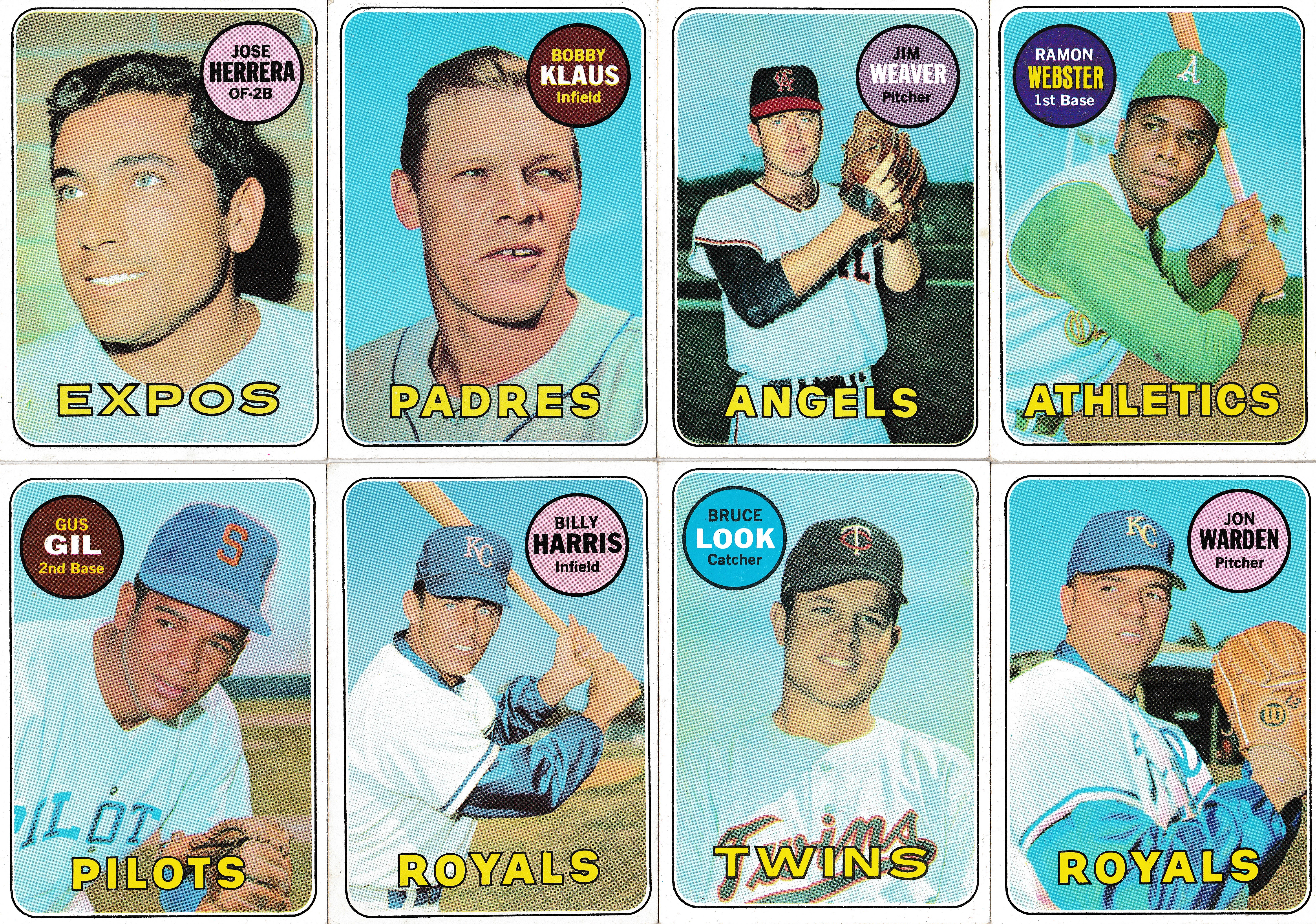
I have 6 more final cards that I was going to post (Billy Harris, Bob Skinner, Dave Adlesh, Galen Cisco, Hank Bauer, and Lou Johnson), but I am going to skip ahead to the recap, because like my other blogs, this blog is sailing off into the sunset, and 7 more posts just isn't gonna happen. 

I posted the final cards recap for the 1966, 1967, and 1968 sets back in 2012, and wanted to get this one completed as well. 
 

The 1969 set includes the final cards for 72 players and 6 managers, all pictured below in order of years of service, from Mickey Mantle's 18 years to Jon Warden's one season.

A few of these guys played their last MLB game in 1968 (Mantle, Nixon, Monbouquette, among others). Others even before that (Gonder in '67, Sheldon in '66), but most of these players wrapped it up in 1969.

Bob Rodgers and Lee Elia would have manager cards in later years.

The always-jovial Joe Schultz is listed last among these 78 cards. I wonder what 2-syllable expression he would use if he knew that?


Monday, June 21, 2021

Rookie Parade

In the past few weeks, I posted all the 1967 and 1968 rookie stars cards. Today we have all the 1969 rookie stars cards. 

Comparison of the 3 sets: 
 
1967 set 
Total cards - 43 
Teams with 3 cards - 5 
Teams with 2 cards - 9 
Teams with 1 card - 6 
Mixed teams - 4 cards 
 
1968 set 
Total cards - 30 
Teams with 3 cards - Orioles 
Teams with 2 cards - 6 
Teams with 1 card - 12 
Teams with 0 cards - Giants 
Mixed teams - 3 cards 
 
1969 set 
Total cards - 52 
Teams with 4 cards - Padres, Royals 
Teams with 3 cards - 6 
Teams with 2 cards - 7 
Teams with 1 card - 8 
Teams with 0 cards - Senators 
Mixed teams - 4 cards 
 
As with the Giants in the 1968 set, there is no rookie stars card for the Senators here. The Senators had no major prospects, but Topps couldn't slap 2 schmoes on a Senators card, like they did here for the Angels and Athletics? 
 
 
Two teams had a whopping FOUR rookie stars cards. 
Of course they are expansion teams, whose rosters were filled with youngsters looking for a shot at the big leagues.
Bill Davis is back for the fifth of his FIVE rookie stars cards, this time not with the Indians. 
 
 
Six teams had three rookie stars cards:
Not much to talk about here. Carl Morton's breakout year was 1970. 
 
Probably the best rookie stars card in the 1969 set is the Richie Hebner/Al Oliver card. It's the only one where both players became stars. The Phillies' Larry Hisle and Don Money both became regulars. Sure, the Phillies were a bad team filled with holes, but Hisle and Money were both selected to the Topps All-Rookie team at the end of the season. 
 
Carlos May was the most successful of these 14 players. 
 
 
Seven teams had two cards: 
 

After trading Joe Torre, the Braves carried two rookie catchers in 1969. Bob Didier ended up as the starter. As a kid, I thought that 2nd Cubs card looked strange. One guy has no ears, while the other two have ears to spare. 

What, no George Korince? Topps finally stopped putting Korince on Tigers Rookies cards, ending the possibility of another Bill Davis-type run. Still, Korince appeared on TWO rookie cards in one year, something Davis didn't achieve. 
Graig Nettles is the best of this bunch. With a name like MITTerwald, you just knew he had to be a catcher. 
 
 
Eight teams had just one rookie stars card:
After several seasons having three rookie cards, the Orioles had just one in the 1969 set. I guess their top-notch roster had no room for any more rookies. This is Lou Piniella's 4th rookie stars card (each with a different team). He was the AL Rookie of the Year in 1969, so this would be his last rookies card. 
 
 
No Senators rookie card? Topps was just lazy here. After some of the players found on these cards over the years, Topps can't use "lack of prospects" as an excuse. 
 
 
Finally, the "miscellaneous rookies from multiple teams" cards.
My contention has always been that Topps decided on the players for these high-numbered cards after the current season had already started. Hard to believe Rollie Fingers was an afterthought. 

And why John Miller? Isn't a player automatically not a "star" when his stated position is "INF-OF"?

Sunday, June 20, 2021

Final Card: Jose Vidal

I've got 7 more cards to post before I can wrap up the "Final Cards" for the 1969 set (something I did way back in 2012 for the 1966, 1967, and 1968 sets), so let's get to it.
 
 
Jose Vidal (#322) had a very short major-league career: a few dozen games for the Indians from 1966-68, and 18 games for the Seattle Pilots in 1969. 
 
Vidal was signed by the Giants in 1958 (I learned something new today) and after one minor-league season was dealt to the Pirates. He spent 5 seasons in Class B, C, and D ball before advancing to Class A in 1963. Primarily an outfielder, Jose also played some 3rd base in '59 and '63. 
 
The Indians purchased his contract in September 1963, and moved him up to double-A the following season. He saw his most extensive playing time in 1965 and 1966, playing over 100 games each season for the Tribe’s AAA team in Portland. 
 
Although he hit well in the minors (40/162/.340 in 1963), he led his league’s outfielders in errors 3 times. 
 
He made his major-league debut with 17 games in September 1966. Initially used as a pinch-hitter, he also started 10 of the final 12 games, mostly in right field. 
 
Jose split his time in '67 and '68 between the Indians and Portland. Although only playing 16 and 37 games for Cleveland in those seasons, he must have been with the team for much of the time because after 100+ games in AAA for the previous 2 seasons, he only played 69 and 44 games in the minors. 
 
In early-September 1968, the expansion Pilots purchased his contract from the Indians. (This was a month before the expansion draft.) Vidal played only 18 games for the Pilots in 1969 (all in the first 4 weeks of the season), mostly as a pinch-hitter. On May 19th he was traded to the Yankees for outfielder Dick Simpson, but spent the rest of the year with the Yankees' AAA team in Syracuse. 
 
Jose played all of 1970 with Syracuse, and part of 1971 with the Tigers' AAA team in Toledo. He finished out that season in Japan, then played over 100 games per season in Mexico from 1972-75. 
 
Vidal passed away in 2011 at age 70. 
 

Saturday, May 29, 2021

Final Card: Bruce Look

This is the first and last card for Bruce Look (#317). 
 
Look was signed by the Milwaukee Braves in 1964. After that season, the Dodgers selected him in the first-year minor-league draft. 
 
After the 1967 season the Twins selected him in the Rule 5 draft. As such, he was required to stay on the Twins’ roster for all of 1968.
Look got a 59-game look (see what I did?) by the Twins in ’68. Earl Battey had just retired, and Jerry Zimmerman (who started 81 games in 1967) was now 33 years old and limited to just 24 games (18 starts) in his final 1968 season. 
 
Who picked up the slack? John Roseboro was acquired from the Dodgers, starting 105 games in his first of 2 seasons with Minnesota. So that left Bruce as the #2 catcher for 1968. Of his 59 games, he only caught in 41 games, with most of his 29 starts coming in May and June.
 
He was one-and-done though, as Roseboro again started the majority of games in 1969 (making the All-Star team) while rookie George Mitterwald served as the backup. 
 
Bruce played 1969-71 back in triple-A – 2 seasons for the Twins, then splitting 1971 between the Yankees’ and the Brewers’ organizations. 
 
Look was traded to the Orioles after the '71 season, but chose to retire.
 
His brother Dean played briefly for the 1961 White Sox, then became an NFL official (calling the TD on Dwight Clark's "The Catch").

Saturday, April 24, 2021

AL Pitching Leaders (#7, #9, #11)

Completing my 4-post sweep of the league leaders cards are the AL Pitching leaders for 1968.
As usual, the Indians are well-represented, with 5 of the 10 slots. Luis Tiant appears on all 3 cards!
 
But the White Sox (who regularly appeared here for the last few years) are nowhere to be found - replaced by 2 appearances each for Dave McNally and Denny McLain. (McLain was fresh off his 31-win performance and World Series championship.)
 
Besides McLain, the other (mere) 20-game winners were McNally, Tiant, and Mel Stottlemyre, with Mel keeping these cards from being just a 4-person Indians/Tigers/Orioles production.

Saturday, March 27, 2021

AL Batting Leaders (#1, #3, #5)

These are the 1968 AL leaders in batting average, RBI, and home runs.
One year after his Triple Crown season, Yaz led the AL in batting again (although with only .301). 
Frank Howard (and surprisingly, Ken Harrelson) appear twice on these cards.
FOUR grand slams for the Tigers' Jim Northrup!
 
I got all these cards in 1969. I wonder why the RBI card has retained its bright white back while the others have yellowed.
 
Re-cap: 
Red Sox - 3 
Senators - 2 
Tigers - 2 
Twins - 1 
Athletics - 1 


Thursday, February 4, 2021

NL Pitching Leaders (#8, #10, #12)

Here are the National League ERA, Wins, and Strikeout leaders for 1968. 

1968 was the Year of Bob Gibson, and he appears on all 3 cards. His 1.12 ERA is astounding.

The Cubs' Fergie Jenkins is among the leaders in 2 categories.  Bob Veale, usually among the strikeout leaders, is 3rd in ERA.

In his second season since replacing the retired Sandy Koufax in the Dodgers' rotation, Bill Singer was 3rd in strikeouts.

Sunday, January 24, 2021

NL Batting Leaders (#2, #4, #6)

These are the 1968 NL leaders in batting average, RBI, and home runs. 
 
Matty Alou appears on the Batting Average leaders card for the 3rd consecutive year. He was 1st on the '67 card, 3rd on the '68 card, and 2nd here. (Felipe was also on the '67 card.)
 
Willie McCovey is the only one appearing twice.  (There always seem to be several players on multiple cards in the AL.)  
 
The Cubs are well-represented with Banks, Santo, and Williams.

Sunday, December 27, 2020

Final Card: Gus Gil

Here’s infielder Gus Gil, sporting the new Pilots’ uniform on a late-series card. 

Gil was signed by the Reds in 1959, and played 8 seasons in their minor-league system, including the last 3 in triple-A.

After the 1966 season, the Indians purchased his contract and installed him as their Opening-Day 2nd baseman for 1967. After starting 19 consecutive games, he was benched in favor of Pedro Gonzalez. When Gonzalez and Chico Salmon failed to get the job done, Gus started the first 4 games in July, but by mid-month was sent to the minors until a September recall.

Gil spent all of 1968 in the minors, then was traded to the expansion Pilots in May 1969 for infielder Chuck Cottier. He started 27 games at the hot corner and another dozen at 2nd base, but by mid-season the Pilots settled on John Donaldson at 2nd and Tommy Harper at 3rd base. 
 
Gus hung on with the Brewers for parts of 1970 and 1971, then played for the Astros’ AAA team from 1972-74. 
 
After splitting the 1975 season between the AAA clubs of the Dodgers and Padres, he played in Mexico in 1976 before retiring. 
 
Gil passed away in 2015 at age 76.

Wednesday, November 25, 2020

Final Card: Jon Warden

Jon Warden (#632) only pitched 1 season in the major leagues – for the World Champion Tigers in 1968. 
 
Warden was signed by the Tigers in 1966, and pitched in their farm system for 2 seasons, mostly as a starter. 
 
 
Jon made the Tigers’ squad at the start of the 1968 season, and was converted to a reliever. Until veterans Don McMahon and John Wyatt were acquired in mid-season, the Tigers’ bullpen was mostly rookies and 2nd-year men. 
 
Warden appeared in 28 games for Detroit, posting a 4-1 record. He was with the Tigers for the entire season, save for National Guard assignments. 
 
He only pitched once after August, as the team was battling for the AL title.  With so many relievers (including the veterans), management tried to hide him from the Kansas City and Seattle scouts, fearing he would be lost in the upcoming draft. The Tigers won the World Series, but their stashing of Warden backfired, as he was selected by the Royals in the expansion draft. 
 
An injury during spring training 1969 set him back, and he played all of 1969-70 for the Royals’ AAA team. 
 
Warden moved on to the Brewers' and Cardinals’ organizations in 1971, but never made it back to the majors. Retiring after the 1971 season, he attempted a comeback with the White Sox in 1974 but did not make the team. 
 
Since his playing career he has been a high school teacher and baseball coach, and a frequent attendee at the Tigers’ fantasy baseball camp. 


Thursday, November 12, 2020

Final Card: Ron Willis

Ron Willis was a relief pitcher for the Cardinals and others for 5 (essentially 4) seasons from 1966-70. Willis was signed by St. Louis in 1961, and was an outfielder/3rd baseman for their class-D team that season, playing 65 games but also making 3 appearances on the mound, totaling 5 innings. 

In 1962 he converted to full-time pitching, and worked his way up the organizational ladder as a starting pitcher until converting to relief in 1966. He made his major-league debut in September 1966. 


Ron made the Cardinals at the start of 1967, and was a key member of the bullpen for the next 2 seasons, pitching in 65 and 48 games as the Cardinals marched to the NL pennant in those seasons. He appeared in 3 games in each of the 2 World Series. 

In 1969 he fell out of favor, as rookies Mike Torrez and Chuck Taylor, as well as the newly-acquired Dave Giusti and Mudcat Grant received more playing time than Willis. He also spent some time in triple-A, and by early-August was sold to the Astros. 

He only pitched 2 innings for the ‘Stros in the final 2 months, and was returned to the Cardinals in November. 

Ron began the 1970 season with the Cards’ double-A team, then was purchased by the Padres in mid-June. He pitched 56 innings over 42 games in the second half, his last appearance coming on September 29th. 

That was it for his pro career – not even minor-league ball after 1970. I wonder if he was injured in 1971’s spring training. After two (‘67, ‘68) and a half (‘70) good seasons, it seems odd that he would retire at age 26. 

Willis passed away in 1977 at age 34.


Friday, October 16, 2020

Final Card: Carroll Sembera

Carroll Sembera pitched for the Astros and Expos from 1965 to 1970. This is his final Topps card (#351). 

Sembera was signed by the Houston Colt .45s in 1961, and played 4 seasons (1962-65) in their farm system before making his major-league debut with 2 games in September 1965. He was mostly a starting pitcher for those 4 seasons.

 
He split the 1966 season between the Astros and their AAA club in Oklahoma City, but was only used in relief by both teams. 
 
Carroll was with the Astros for all of 1967, making 45 relief appearances (2nd on the team behind Dan Schneider). 
 
In 1968 the Astros completely revamped their bullpen, replacing 1967 members Schneider, Barry Latman, Sembera, Dave Eilers, and Larry Sherry with John Buzhardt, Danny Coombs, and rookies Jim Ray, Tom Dukes, and Steve Shea. As such, Sembera toiled in triple-A all season, starting about two-thirds of his games. 
 
After the season he was selected by the Expos in the Rule 5 draft (not the expansion draft). He began the season with Montreal, but by early-June was demoted to the minors, where he remained until his September recall. 
 
In 1970, once again he started the year with the Expos, but after his first outing his ERA was 81.00. He pitched in 4 more games, but this time didn’t make it to May. 
 
After 2 games with triple-A Winnipeg, he was traded to the Cardinals for pitcher Bill Dillman. The Cards kept him in triple-A for the rest of 1970 and all of 1971, before trading him to the Reds. 
 
He finished his career with the Reds’ AAA team in 1972. 
 
Carroll was a scout for the Mariners for eleven years after his playing career. 
 
Sembera passed away in 2005 at age 63. 
 

Monday, August 17, 2020

Final Card: Joe Gordon

Unlike the last card posted on this blog (Tom Burgmeier) this is an early-season card (#484), which means an airbrushed gem for an expansion team member.

Joe Gordon made his final managerial stop with the 1st-year Kansas City Royals in 1969.


Much earlier, Joe was the Yankees' 2nd baseman from 1938-43, and 1946 (missing 2 years during World War II). Some of his teammates were Lou Gehrig, Joe DiMaggio, and Bill Dickey.  (He missed Babe Ruth by 4 years.)

Gordon was a 6-time All-Star, and the 1942 American League MVP.

After the 1946 season he was traded to the Indians for pitcher Allie Reynolds. Joe was their 2nd baseman for the next 4 seasons, and made 3 more trips to the All-Star game. In 1948 he led the Tribe in home runs and RBI (as a 2nd baseman!)

He was released after the 1950 season (odd, being 1-year removed from an All-Star appearance, and having played 119 games in 1950).

---

Gordon was a player-manager for the PCL’s Sacramento team from 1951-52 then scouted for the Tigers for several seasons before returning to manage the Red Sox' San Francisco team in the PCL from 1956-57.

Joe was the Indians' manager from midway through the 1958 season to mid-1960. In August 1960, he was traded to the Tigers for Jimmie Dykes (a manager-for-manager trade!)

Let go after the season, he managed the Kansas City Athletics for the first 59 games of the 1961 season, before owner Charley Finley canned him.

Gordon scouted for the Angels from 1961-68, then managed the expansion Royals for one season, piloting them to 4th place (ahead of the established White Sox and expansion Pilots), then retired after the season at age 54.

He passed away in 1978 at age 63.

Gordon was inducted into the Hall of Fame in 2009.

Friday, July 17, 2020

Tom Burgmeier (#558)

Tom Burgmeier was one of the good, young pitchers selected by the Royals in the expansion draft prior to the 1969 season. I thought he began his career in the Angels' organization, but I learned today that he was signed by the Houston Colt .45s in the Fall of 1961.

After 2 ½ season on the Colts' farm he was released in June 1964, but picked up by the Angels the following month.

Tom made his major-league debut with the Angels in 1968. He did not have any baseball cards as an Angel, because Topps missed the boat on many of their young pitchers from 1966-68. A custom card can be found in this blog post. This late-series 1969 card, featuring the new Royals’ uniform is his rookie card.


Burgmeier pitched in 745 games over his 17-year career, all but 3 in relief. He was a key member of the Royals' bullpen from 1969-72, fashioning a 24-16 record in 190 games over those 4 seasons, with 27 saves. 17 of those saves were in 1971, and he led the 1972 team with 9 saves.

It all came crashing down in 1973. He pitched 6 games in the first month of the season, but spent the remainder of the year in the minors.

After the season he was traded to the Twins for a minor-leaguer. Tom pitched for the Twins from 1974-77, and led the team with 11 saves in 1975.

Granted free agency, he signed with the Red Sox in 1978, and spent the next 5 seasons in Boston. In 1980 he led the team with 24 saves, and was named to his only All-Star team.

He played his final 2 seasons (1983-84) with the Athletics. In 17 seasons, his teams never made it to the playoffs.

Saturday, June 27, 2020

Mike Kekich (#262)

Mike Kekich is mostly known for his years with the Yankees, but he began his career with the Dodgers.

Signed by the Dodgers in 1964, he pitched 24 games in A ball (and only 1 in AAA) before making the jump to the majors in 1965. He must have been injured that season, because he only pitched 5 games for LA, and 7 in the Arizona Instructional League.

After pitching all of 1966-67 in the minors, Kekich returned to the Dodgers at the start of the 1968 season. He started 20 of his 25 games as the 5th starter in a rotation that included Don Drysdale, Claude Osteen, Bill Singer, and Don Sutton.


After his rookie season, he was shipped off to the Yankees for outfielder Andy Kosco. (Whaaaaaaat?)

Mike played for the Yankees for the next 4+ seasons. After splitting the #5 starter assignments with Al Downing in 1969, and the #4 starter's job with Steve Kline in '70, he was in the regular rotation in '71 and '72. His best season was 1971, posting a 10-9 record with 93 strikeouts. He also won 10 games in 1972.

Kekich began the 1973 season in the Bronx, but was traded to the Indians in June for pitcher Lowell Palmer. He was released during spring training in 1974 but soon hooked on with the Rangers.

He didn’t play in the majors during 1974, splitting that season between the Rangers' AAA team in Spokane, WA and also playing in Japan. He returned to the Rangers in 1975, relieving in 23 games, but with no decisions. He also spent time back in Spokane.

Mike missed the entire 1976 season, then made a comeback in 1977 with the Mariners, playing in 41 games (all but 2 in relief).

He played in the minors during 1978 and in the Inter-American League in 1979 before retiring.

Friday, May 22, 2020

Final Card: Jim Lemon

This is Jim Lemon's 2nd and final card as a manager (#294). It's the same photo Topps used for his 1968 card.

As the comment on the back indicates, Lemon wasn't the team's manager. After finishing last in his only season as a skipper, THREE MONTHS LATER he was canned in favor of Ted Williams, who has a card later in the set.


I'm wondering why, if Topps knew about his firing (to be able to add the note on the back), why did they even include a card for him? Why not pull it and replace it with, oh I don't know, maybe a SENATORS ROOKIE STARS CARD?

Prior to managing, Lemon was an outfielder for the (old) Senators and Twins, which you can read about here. He was also a coach for the Twins from 1965-67, and 1981-84.

Lemon passed away in 2006 at age 78.

Sunday, April 26, 2020

Jim Gosger (#482)

This is a late-series 1969 card, showing Jim Gosger in his new Seattle Pilots uniform. (It’s too bad Topps didn’t think ahead, and put all the expansion team players in the later series, so they had time to get good photos of all the players.) 

Gosger was signed by the Red Sox in 1962, and made his big-league debut with the Sox in May 1963. He played in 19 games that season, mostly as a pinch-hitter or pinch-runner, although he made 2 starts in center field in the season’s final week.

Jim was back in the minors for all of 1964 and the first half of 1965. Beginning on July 9th, he made 19 consecutive starts in center field (replacing Lenny Green), then moved over to right field for the 18 of the next 20 games, while Tony Conigliaro was out of the lineup. When Tony C. returned to the lineup on 8/20, Gosger moved back to center field for the final 42 games. All told, he started 79 of the final 81 games after his recall.


For the first two months of the 1966 season he alternated in center field with Green and George Thomas, then was traded to the Athletics (with pitchers Guido Grilli and Ken Sanders) for outfielder Jose Tartabull and pitchers John Wyatt and Rollie Sheldon. That year, left and center fields were a carousel for the Athletics (with only right fielder Mike Hershberger getting regular playing time). Jim split his time between left and center fields, sharing the starts with Joe Nossek, Roger Repoz, Larry Stahl, and Danny Cater.

Hopefully he made the most of that 1966 mish-mash, because Rick Monday joined the squad in 1967, taking over the center field job in game #10 and for several years thereafter. Gosger was the team's 3rd outfielder in terms of innings played, but he was backing up at all three spots (with Cater starting more in left field than Gosger).

His playing time decreased even more in 1968. Reggie Jackson was in his first full season, moving Hershberger over to share left field with rookie Joe Rudi, and sending Gosger to the bench.

Jim was selected by the Seattle Pilots in the October 1968 expansion draft, and was the team's starting center fielder for 10 of the first 14 games. He was soon replaced by Wayne Comer, and by mid-season was sent to the Mets in exchange for Greg Goossen. He spent the rest of the season in triple-A, only returning to the Mets for 10 games in September, and was not on the Mets' post-season roster.

After the 1969 season Gosger was traded to the Giants for pitcher Ray Sadecki and outfielder Dave Marshall, but before playing any games for San Fran, he was acquired by the Expos in late-April 1970.

For 1970 and 1971, Jim played parts of both seasons with the Expos while also spending a lot of time with their AAA team.

After the 1971 season he was traded back to the Mets for 4 minor-league players. He played for the Mets' AAA team from 1972-74, while also appearing in a few dozen games for New York in '73 and '74.

Gosger was released on 10/1/74 (the Mets didn't waste any time!) ending his 10-year career.

Although very much alive, last year the Mets mistakenly included him in a video honoring deceased ex-Mets.

Wednesday, April 15, 2020

Mike Lum (#514)

Mike Lum first appeared on a "National League Rookies" card in the 1968 set.

He made his major-league debut in September 1967. He was signed by the Milwaukee Braves in 1963, and after 5 seasons in the minors (and his Sept '67 cup of coffee), he made the team in 1968.

Lum was the 3rd outfielder, behind Felipe Alou (CF) and Hank Aaron (RF). However, he played less than half as many innings as they did, and was so close to the next two (Tito Francona and Tommie Aaron) that they could all be considered third outfielders as they manned left field during Rico Carty's 1-year absence.


With Carty's return in 1969 plus the acquisitions of Tony Gonzalez and Bob Aspromonte, left field was quite crowded, leaving Lum with little to do but pinch-hit.  Of his 121 games, he only started 32, across all three positions.

Alou was traded away after 1969 but that just gave Gonzalez more playing time in 1970. In 1971 the Braves’ outfield was completely revised. Gone were Hank Aaron (moved to 1B), Gonzalez, and Carty. In were Lum (RF), Sonny Jackson (CF) , and Ralph Garr (LF).

Mike got 350 to 500 at-bats every season through 1975 while splitting his time between the outfield and first base.

After the 1975 season he was traded to the Reds for shortstop Darrel Chaney.  He spent the next 3 seasons as the Reds' 4th outfielder. (When the first three are named Foster, Geronimo, and Griffey, that means you are a pinch-hitter.)

Lum was granted free agency after 1978 and returned to the Braves as a backup 1st baseman and pinch-hitter. Released in May 1981, he pinch-hit for the Cubs for the rest of that season.

Mike played in Japan in 1982, then began a long coaching career. He was a hitting coach for the Braves, White Sox, Giants, and Royals from 1983-89. Since 1990 Lum has been a minor-league instructor for the White Sox, Brewers, and Pirates.