Showing posts with label ...baseball brothers. Show all posts

Saturday, May 29, 2021

Final Card: Bruce Look

This is the first and last card for Bruce Look (#317). 
 
Look was signed by the Milwaukee Braves in 1964. After that season, the Dodgers selected him in the first-year minor-league draft. 
 
After the 1967 season the Twins selected him in the Rule 5 draft. As such, he was required to stay on the Twins’ roster for all of 1968.
Look got a 59-game look (see what I did?) by the Twins in ’68. Earl Battey had just retired, and Jerry Zimmerman (who started 81 games in 1967) was now 33 years old and limited to just 24 games (18 starts) in his final 1968 season. 
 
Who picked up the slack? John Roseboro was acquired from the Dodgers, starting 105 games in his first of 2 seasons with Minnesota. So that left Bruce as the #2 catcher for 1968. Of his 59 games, he only caught in 41 games, with most of his 29 starts coming in May and June.
 
He was one-and-done though, as Roseboro again started the majority of games in 1969 (making the All-Star team) while rookie George Mitterwald served as the backup. 
 
Bruce played 1969-71 back in triple-A – 2 seasons for the Twins, then splitting 1971 between the Yankees’ and the Brewers’ organizations. 
 
Look was traded to the Orioles after the '71 season, but chose to retire.
 
His brother Dean played briefly for the 1961 White Sox, then became an NFL official (calling the TD on Dwight Clark's "The Catch").

Tuesday, December 31, 2019

Joe Keough (#603)

This is Joe Keough’s rookie card. (I was sure he had a card in the 1968 set, but was unable to find one.) Joe is the younger brother of Marty Keough, who played for the Red Sox, Reds and others from 1956-1966.

Joe was drafted by the Kansas City Athletics in the 2nd round of the 1965 draft, right after they selected Rick Monday at #1 (and ahead of Sal Bando and Gene Tenace).   He played for their class A team in 1966 and 1967, then split the 1968 season between Oakland and their AA team.

Look at me – correcting Topps’ mistake with Keough’s bats/throws info back in 1969. 

Keough was drafted by the Royals with the 8th pick in the 1968 expansion draft.

Joe started 12 of the first 14 games in right field in the Royals’ first season, but soon found himself on the bench, and by late-May was back in the minors. He returned to the Royals in mid-July, but was mostly a spare outfielder.

In 1970 he was the 4th outfielder, backing up Lou Piniella and Pat Kelly at the corner spots. He missed the second half of the season due to a broken leg.

Joe was the team’s primary right fielder in 1971, starting 87 games there and another six games in center field.

Richie Scheinblum was acquired in 1972, and took over the right field spot (while also making the All-Star team), pushing Keough all the way down to #6 outfielder.

Joe was traded to the White Sox in February 1973 for outfielder Jim Lyttle, but only appeared in 5 games (with one at-bat) for the Sox. After a full season with Chicago’s AAA team, he was sold to the Twins in October 1973, but retired before 1974.

Keough passed away in September 2019 at age 73.

Tuesday, April 8, 2014

Hank Aaron (#100)

Today is the 40th anniversary of Hank Aaron breaking Babe Ruth's career home run record.

Here we see Hank, fresh off his 1968 season, the year he joined the 500-homer club.


Of Aaron's 755 career homers, 375 were hit in the 1960s, good for 2nd place behind Harmon Killebrew. (You can see the chart of 1960s sluggers in Killebrew's post.)

Hammerin' Hank broke the record on April 8, 1974, during the Braves' first home game of the season. It came in the 4th inning (his 2nd at-bat) off Dodgers' starter Al Downing.

Sunday, March 30, 2014

Joe Niekro (#43)

Joe Niekro was one of several sets of brothers who played in the majors in the 1960s. Like his older brother Phil, Joe was a knuckleball pitcher.

Joe was signed by the Cubs in 1966, and after only one season in the minors, he made his big-league debut in April 1967. He pitched 36 games (22 starts) as a rookie, and finished 3rd in innings pitched on the Cubs’ staff, behind Fergie Jenkins and fellow rookie Rich Nye.

Niekro was a member of the starting rotation for 2 seasons, then in late-April 1969 he was traded to the Padres for pitcher Dick Selma. Joe finished out the season with San Diego, then was traded to the Tigers for pitcher Pat Dobson.


Niekro spent played for the Tigers for all of 1970-71, and part of 1972. He spent the remainder of 1972 and most of 1973 in the Tigers’ farm system.

When the Braves claimed him off waivers in early August 1973, he joined the Braves for the rest of the season (uniting him with brother Phil), and made 20 relief appearances. Joe split his time between the Braves and their AAA team in 1974, then was sold to the Astros 2 days before the start of the 1975 season.

Niekro enjoyed his greatest success during his 11 seasons with the Astros. In 1979 he led the NL with 21 wins, made the all-star team, and finished 2nd in the Cy Young voting. He followed up his great 1979 season by notching 20 wins in 1980, and pitching in the NLCS against the Phillies.

Two weeks before the end of the 1985 season, Joe was traded to the Yankees for pitcher Jim Deshaies. Once again, his brother Phil was a teammate, although Phil was traded away after the season. Joe remained in the Yankees’ starting rotation until his June 1987 trade to the Twins.

Niekro pitched for the Twins for the remainder of the 1987 season (including the World Series vs. the Cardinals), but after pitching 5 games in 1988, he was released in early May, ending his 22-year career.

Niekro passed away in October 2006 at age 61.

Monday, February 24, 2014

Clete Boyer (#489)

Here is Clete Boyer, near the end of his long career. Clete had a Topps card in 1957, and every year from 1959-71. I have all his cards from 1966-70.

Boyer was signed by the Kansas City Athletics in 1955 as a bonus baby, and began his pro career on the Athletics’ major-league roster. He played sparingly in 1955, only making 6 starts at 3rd base (behind future Yankees’ teammate Hector Lopez), while also getting a few starts at 2nd base and left field. In 1956 Boyer started 34 games as the A’s backup 2nd baseman.

In June 1957, after appearing in only 10 games (9 as a pinch-runner) and having no at-bats, Boyer was sent to the Yankees to complete an 11-player trade which included pitchers Art Ditmar and Bobby Shantz going to the Yankees.

Clete spent the remainder of 1957, all of 1958, and June and July of 1959 in the minors, getting the much-needed experience he missed as a bonus baby.


Boyer began the 1959 season with the Yankees, but was sent to the minors for 2 months. When he returned, he was the starting shortstop from mid-August to mid-September. (Regular shortstop Tony Kubek missed 30 games that season, and also played half his games in the outfield.)

Clete rode the bench for the first half of 1960, then won the 3rd base job from long-time Yankees’ infielder Gil McDougald (who was in his final season), and started 92 of the final 118 games at the hot corner.

With the retirement of McDougald, Boyer had 3rd base to himself in 1961, making 138 starts along with another 8 starts at shortstop. Clete continued as the regular 3rd baseman through the 1965 season, while making occasional starts at shortstop.

1966 was a strange season. During the first half, left fielder Tom Tresh (who had played the first 4 ½ months of the 1962 season at shortstop in Kubek’s absence) was moved to 3rd base, with Boyer becoming the regular shortstop. This arrangement continued until late-June, when Tresh returned to left field, Boyer to 3rd base, and Horace Clarke installed as the regular shortstop.

In November, Clete was traded to the Braves for outfield prospect Bill Robinson and reliever Chi-Chi Olivo. Boyer took over the Braves’ hot corner from long-time veteran slugger Eddie Mathews, who was traded to the Astros a month later.

Clete hit a career-high 26 home runs in 1967, and played 4 ½ seasons for the Braves (although missing the last 2 ½ months of the 1968 season). He was released by the Braves at the end of May 1971, after clashing with the Braves’ manager and general manager.

After playing the remainder of the ’71 season for the Padres’ AAA team in Hawaii (nice work, if you can get it!), Clete played in Japan from 1972-75.

Boyer played in the World Series with the Yankees every season from 1960-64, and in the 1969 NLCS with the Braves. He also won a Gold Glove in 1969.

Clete’s brother Ken was a 3rd baseman from 1955-1969 (mostly with the Cardinals). They both played 3rd base in the 1964 World Series. His other brother Cloyd was a pitcher with the Cardinals from 1949-52, and was Clete’s teammate with the 1955 Athletics.

Clete passed away in June 2007 at age 70.

Tuesday, October 16, 2012

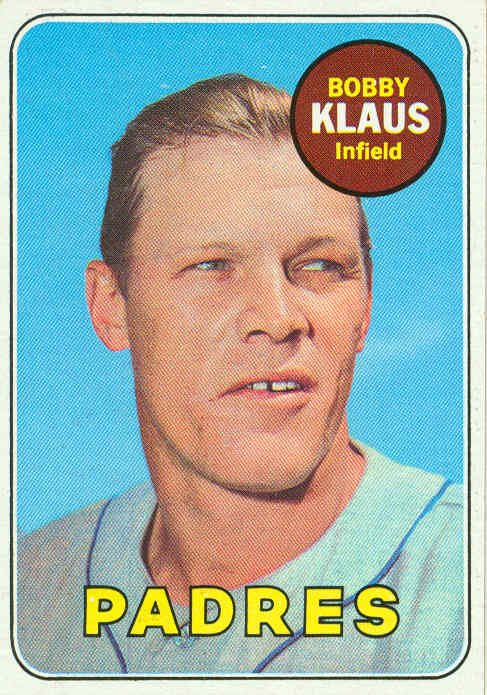
Final Card: Bobby Klaus

This is the final card for Bobby Klaus (#387). He has a card in this set, even though his last major-league appearance was in 1965.

Klaus was signed by the Reds in 1959, and played in their minor-league system for 5 seasons, the last two with the Reds' triple-A San Diego Padres.

Bobby made his major-league debut in April 1964 with the Reds, but was traded to the Mets in late July. He played for the Mets through the end of the 1965 season. Those 2 years (64-65) were to be his only time in the big leagues.


In February 1966, Klaus and catcher Jimmie Schaffer were traded to the Phillies for 1st baseman Dick Stuart. After 2 seasons in the bigs, Bobby was back with the triple-A San Diego Padres, now part of Philadelphia's farm system. He would remain there through the 1968 season.

After the fall 1968 expansion draft, the (major-league) San Diego Padres selected him in the Rule 5 draft (explaining why he has this card). Before the '69 season started, he was traded to the Pirates with outfielder Ron Davis for pitcher Tommie Sisk and catcher Chris Cannizarro. Klaus played that season with the Pirates' AAA team in Columbus before retiring.

Bobby's brother Billy was an infielder with the Red Sox, Orioles, Senators, and Phillies from 1956-63.