Showing posts with label ...back on Topps' radar. Show all posts

Sunday, December 27, 2020

Final Card: Gus Gil

Here’s infielder Gus Gil, sporting the new Pilots’ uniform on a late-series card. 

Gil was signed by the Reds in 1959, and played 8 seasons in their minor-league system, including the last 3 in triple-A.

After the 1966 season, the Indians purchased his contract and installed him as their Opening-Day 2nd baseman for 1967. After starting 19 consecutive games, he was benched in favor of Pedro Gonzalez. When Gonzalez and Chico Salmon failed to get the job done, Gus started the first 4 games in July, but by mid-month was sent to the minors until a September recall.

Gil spent all of 1968 in the minors, then was traded to the expansion Pilots in May 1969 for infielder Chuck Cottier. He started 27 games at the hot corner and another dozen at 2nd base, but by mid-season the Pilots settled on John Donaldson at 2nd and Tommy Harper at 3rd base. 
 
Gus hung on with the Brewers for parts of 1970 and 1971, then played for the Astros’ AAA team from 1972-74. 
 
After splitting the 1975 season between the AAA clubs of the Dodgers and Padres, he played in Mexico in 1976 before retiring. 
 
Gil passed away in 2015 at age 76.

Sunday, November 11, 2018

Final Card: Chuck Harrison

After being left out of the 1968 card set, Chuck Harrison returned for one last card (#116) – this time as a member of the expansion Kansas City Royals.

Harrison was signed by the Houston Colt .45s in 1963, and made his major-league debut with 12 games in September 1965.

He was the Astros' regular 1st baseman in 1966, playing in 119 games, but 9 home runs and 52 RBI aren't very much for a corner infielder.

After starting 113 games in '66, he spent much of the 1967 season on the bench, only starting 44 games, with newly-acquired Eddie Mathews replacing him at 1st base.


In October 1967 Chuck was included in the trade that sent Sonny Jackson to the Braves in return for pitcher Denver Lemaster and shortstop Denis Menke.

Harrison spent the entire 1968 season playing at triple-A Richmond. Three days after the expansion draft, the Royals purchased both Harrison and Dave Nicholson (also missing from the 1968 Topps set) from the Braves.

Chuck was with the Royals for all of 1969, but only played 75 games, as the team went with ex-Orioles prospect Mike Fiore as their first baseman.

Harrison spent all of 1970 and the first half of 1971 in the minors, before returning to KayCee in June 1971 to play his final 49 major-league games.

He hung up his spikes after playing for the Rangers’ AAA Denver team in 1972.

Thursday, November 24, 2016

Final Card: Larry Miller

Here is the final card (#323) for Larry Miller, who I just discovered a few days ago to be the oldest living player (at age 79) having a card from 1966-70 not yet appearing on one of my blogs.

He is also "Back on Topps' Radar", with his first card since the 1965 set. (Miller spent most of '66 and all of 1967-68 in the minors.)


Miller was signed by the Dodgers in 1959, and played in their organization for 3 ½ seasons (plus a 2-year break for military service) before making his major-league debut in 1964. He pitched in 16 games over the second half of the season. He was 4-8 in 14 starts.

After the season he was traded to the Mets for OF-1B Dick Smith. Miller split the 1965 season between the Mets and their AAA team in Buffalo.

Larry was back in AAA for the 1966 season, followed by 4 late- September appearances for the Mets.

He was in triple-A for all of 1967-69, and was traded to the Giants' organization in mid-1967. Since his last big-league game was in 1966, I'm wondering "Why does he have a card?"

Sunday, March 6, 2016

Back on Topps' Radar: George Thomas

Outfielder George Thomas (#521) rejoined the Topps baseball set in 1969, after a 1-year absence. George had cards every year from 1961 to 1971, except for ’68 and ’70.

Most of his cards list him only as an outfielder. This is the only card that added “catcher” to his repertoire. Not sure why – Thomas had been in the majors continuously from 1961 to 1967, and only caught 3 innings in ’66 and 4 innings in ’67 during that time.

George was signed by the Tigers in August 1957 as a bonus baby. He remained on Detroit’s roster for the remainder of the season, getting only 1 at-bat.


Thomas returned to the minors for 1958 and remained down on the farm through the end of the 1960 season. He began the ’61 season with the Tigers, but was sold to the Los Angeles Angels in June. He shared the right field job with Albie Pearson, and also started 3 dozen games at third base.

George was the team’s 4th outfielder in 1962, playing mostly in right field. In June 1963 he was traded back to the Tigers, where he remained as an extra man for the next year and a half.

In October 1965, Thomas and George Smith were traded to the Red Sox for pitcher Bill Monbouquette. He played 2 seasons with the Sox (including 2 at-bats in the ’67 World Series) then played most of the 1968 season in the minors.

Thomas played 3 more seasons in a greatly-reduced role before calling it a career. He was released by Boston in late-June 1971. The Twins picked him up on the same day, and he finished out the season with Minnesota until his release in October.

He played 12 seasons, and appeared at every position except pitcher.

Thursday, June 5, 2014

Final Card: Joe Nossek

I’ve got 21 more “Final Cards” to post in the 1969 set, but haven’t done any since last October, so I’m going to squeeze one in here before I start down the path of featuring the Topps All-Rookie Team. Joe Nossek is the only one of the remaining 21 cards to have played more than 5 seasons in the majors. He finished up with 6 years of service time. 


Joe Nossek (#143) was a member of the 1961 College All-American team, along with catcher Bill Freehan, pitcher Bill Faul, and future Twins’ teammate, shortstop Frank Quilici.

Joe was signed by the Minnesota Twins in 1961 and played 4 seasons in their minor-league organization. He made his major-league debut in April 1964, playing in 7 games at the start of the season (mostly as a pinch-runner) before returning to the minors in early May.


Joe returned to the majors on a full-time basis at the start of the 1965 season. He played in 87 games during his rookie season, mostly as a pinch-hitter and backup center fielder (to Jimmie Hall). Joe also made a few starts at 3rd base. Nossek appeared in 6 games in the 1965 World Series, and was the starting center fielder for games 2, 3, 5, 6, and 7 against the Dodgers’ southpaw starters. He went 4-for-20 (.200).

In mid-May 1966, Joe was sold to the Kansas City Athletics. He played in 87 games for the Athletics in both 1966 and 1967, sharing the starting center field job in 1966 with Roger Repoz and Jim Gosger, then caddying for rookie Rick Monday in 1967.

Nossek spent all of 1968 with Oakland’s AAA team in Vancouver, and was left out of the Topps set in 1968. It's surprising that he was back on Topps' radar in 1969. This is a low-numbered card, and he didn't see any playing time in the previous season.

He began the 1969 season with the A’s, but after 13 games (2 starts), he was sent down to the minors in mid-May, then traded to the Cardinals two months later for utility infielder Bob Johnson. The Cardinals called Joe up at the end of July, where he made 9 pinch-hitting or pinch-running appearances over the rest of the season.

It was back to the minors for almost all of 1970, with only one pinch-hitting appearance for the Cardinals in mid-September. It would be his last major-league game.

In February 1971 Joe was sold to the Brewers, but spent the year in triple-A before retiring.

After his playing career, Nossek was a coach for 28 seasons between 1973 and 2003, for the Brewers, Twins, Indians, Royals, and White Sox.

Friday, November 22, 2013

(The other) John Kennedy

Here is the “other” John Kennedy (#631). Unlike the more famous one, this John Kennedy BEGAN his career in Washington DC, and ENDED it in Boston, MA. What they have in common (besides their name) is their May 29th birthday!

Kennedy was signed by the Washington Senators in 1961 (Hmmm.. I wonder if they would have noticed him, had Richard Nixon been the president?), and played in the Nats’ system for 3 seasons, almost exclusively as a shortstop. He also played 14 games with the Senators in September 1962, and 36 games in 1963 (from late-May to early-July, and again in a September call-up).

(Well, he sure has the "Kennedy teeth"!)
 

In 1964, John was with the Senators for the entire season, sharing the 3rd base job with veteran Don Zimmer. Kennedy started half the team’s games there, with another 43 starts at shortstop, spelling Ed Brinkman. However, he only hit .230 with 7 homers, and struck out 119 times.

After the 1964 season, Kennedy was sent with pitcher Claude Osteen and cash to the Dodgers for slugging outfielder Frank Howard, 3rd baseman Ken McMullen, pitchers Pete Richert and Phil Ortega, and first base prospect Dick Nen.

In 1965, the Dodgers employed a carousel of 3rd baseman (I’m sure Night Owl can verify the carousel went on for years, until Ron Cey showed up). The pecking order seemed to be Junior Gilliam, Dick Tracewski, and then Kennedy. The following season, Kennedy and Gilliam each started 52 games at the hot corner, with 2nd baseman Jim Lefebvre also making a few dozen starts there. John was also Maury Wills’ backup at shortstop in 1966.


Kennedy appears as a Dodger in the 1967 Topps set, but a few days before the season he was traded to the Yankees, and served as the backup SS/3B for one season. The Yanks sent him down to the minors for all of 1968, resulting in his absence from the Topps set that year. (He had a card in all other sets from '64 to '73.)

John resurfaced in 1969 as a member of the expansion Seattle Pilots. He played 61 games, mostly as a pinch-hitter, but was also the 3rd or 4th option at shortstop and 3rd base, as the new team used 53 players that season. Kennedy split the first half of 1970 between the Milwaukee Brewers and their AAA team, then was traded to the Red Sox in mid-June.

John was a utility infielder for Boston for the next several seasons, and played his last game on June 16, 1974. He played for Boston’s AAA team for the remainder of the 1974 season, then was released in October, ending his 12-year career.

Monday, February 18, 2013

Final Card: Gary Geiger

After being omitted from the 1968 set, Gary Geiger returns for one final card (#278). Geiger played outfield with the Red Sox from 1959-65, then finished his career with 2 seasons each with the Braves and Astros.

Geiger was signed by the Cardinals in 1954, and played 4 seasons in their minor-league system. After the 1957 season, he was selected by the Indians in the Rule 5 draft, and started 35 games as the backup center fielder to veteran Larry Doby.

After 1 year with the Tribe, Geiger was traded to Boston (with little- used 1st baseman Vic Wertz) for center fielder Jim Piersall, who had been a regular outfielder for the Sox since day 1 in 1953.

(Geiger is incorrectly listed as a right-handed batter on this card.)

In 1959, Gary split time in center field with Marty Keough, then moved to right field the next year, where he shared the position with Lou Clinton. Geiger took over as the every-day center fielder at the start of the '61 season, a post he held until 1963, when he shared center with Roman Mejias.

Gary only played 5 games in 1964, as he was recovering from ulcer-related surgery. He also missed most of the 1965 season, due to a broken hand. After the season, he was selected by the Braves in the Rule 5 draft.

Geiger spent the next 2 seasons in Atlanta, backing up center fielder Mack Jones. He spent all of 1968 with the Cardinals' AAA team, then (after his THIRD Rule 5 selection) made a comeback (of sorts) with the Astros in 1969, playing in 93 games as a backup corner outfielder and pinch-hitter.

Gary spent most of 1970 with the Astros' AAA team, but played his last 5 major-league games in late-June/early-July. He returned to the Cardinals' organization for his final pro season (1971), playing 100 games with double-A Tulsa.

Geiger passed away at age 59 on April 24, 1996.

Tuesday, October 16, 2012

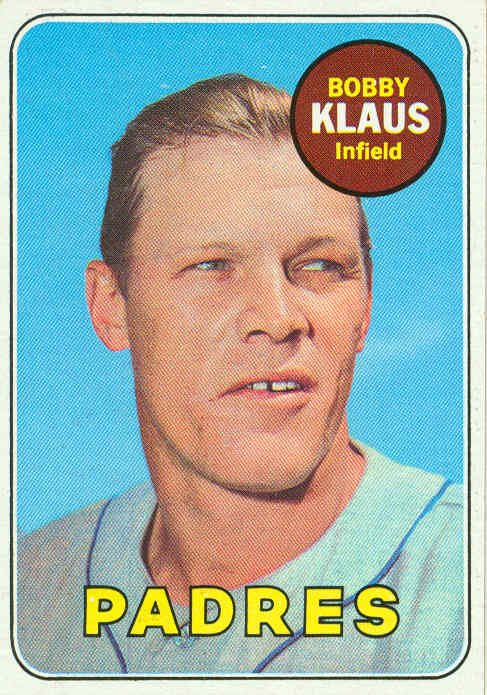
Final Card: Bobby Klaus

This is the final card for Bobby Klaus (#387). He has a card in this set, even though his last major-league appearance was in 1965.

Klaus was signed by the Reds in 1959, and played in their minor-league system for 5 seasons, the last two with the Reds' triple-A San Diego Padres.

Bobby made his major-league debut in April 1964 with the Reds, but was traded to the Mets in late July. He played for the Mets through the end of the 1965 season. Those 2 years (64-65) were to be his only time in the big leagues.


In February 1966, Klaus and catcher Jimmie Schaffer were traded to the Phillies for 1st baseman Dick Stuart. After 2 seasons in the bigs, Bobby was back with the triple-A San Diego Padres, now part of Philadelphia's farm system. He would remain there through the 1968 season.

After the fall 1968 expansion draft, the (major-league) San Diego Padres selected him in the Rule 5 draft (explaining why he has this card). Before the '69 season started, he was traded to the Pirates with outfielder Ron Davis for pitcher Tommie Sisk and catcher Chris Cannizarro. Klaus played that season with the Pirates' AAA team in Columbus before retiring.

Bobby's brother Billy was an infielder with the Red Sox, Orioles, Senators, and Phillies from 1956-63.

Sunday, September 30, 2012

Back on Topps' Radar: Billy Cowan

This is Billy Cowan's first card (#643) since the 1965 set. Cowan's career spanned 1963-1972, but he only had 5 cards during that time. Billy appeared as a Cub in the 1964 and 1965 sets, as a Yankee in the 1969 set, and an Angel in the '71 and '72 sets.

A member of the Phillies' organization from 1966 to 1968, he spent most of that time (except for the 2nd half of 1967) in the minors, effectively eliminating his chance for a card in the 1966-1968 Topps' sets.


Cowan was signed by the Cubs in 1961, and spent the next 3 seasons in the minors, finally making his major-league debut on 9/9/63. He made a half-dozen starts, spelling Billy Williams in LF, Lou Brock in RF, and a host of center fielders.

In 1964, Cowan was the Cubs' regular center fielder (I didn't know that until today), starting 127 games between Williams in left and Brock in right (with Len Gabrielson taking over after Brock's trade to St. Louis). Billy hit .241 with 19 home runs, but rarely started during September.

Before the '65 season, he was traded to the Mets for ex-Cub outfielder George Altman. In 1965, Cowan was a frequent center fielder for the Mets, until his early-August trade to the Milwaukee Braves (for infielders Ernie Bowman and Lou Klimchock).

Billy was traded back to the Cubs in late April 1966 for future Yankees' 3rd baseman and Braves' manager Bobby Cox. Two months later he was traded to the Phillies, and spent the rest of '66 with the Phillies' AAA San Diego club.

Cowan began the '67 season in San Diego, but a roster spot with the Phils opened up in late June, after the team sold Dick Groat to the Giants. With 4 of the Phillies' 5 outfielders (Johnny Callison, Tony Gonzalez, John Briggs, Doug Clemens) all batting from the left side, Cowan was called up to provide a right-handed bat off the bench.

In 1968, the Phillies' Richie Allen became the regular left fielder, creating a logjam in the outfield. As such, Cowan spent the entire season back in triple-A.

After the season, the Yankees selected him in the Rule 5 draft, marking the end of Cowan's days in the minor leagues. He split the 1969 season between the Yankees and Angels, and played for the Angels for the '70 and '71 seasons. Primarily used as a pinch-hitter, he was also a backup outfielder and occasional 1st baseman.

Cowan was released by the Angels on May 2nd, 1972, having only played 3 games that season.

Sunday, August 26, 2012

Final Card: Bob Chance

As with my 1966 and 1968 blogs, I'm down to the last half-dozen (+/-) players whose final card is in this set.

Bob Chance (#523) was a 1st baseman for the Indians and Senators in the mid-1960s. After being out of the majors (and Topps' lineup) in 1968, he returned in 1969, playing 5 games with the Angels.

Chance was was signed by the Giants in 1961, and played outfield for their class-D team in El Paso. After the season, he was selected by the Indians in the minor-league draft. Bob played 1st base and outfield for the next 2 seasons with the Tribe's Charleston WV team, which was class A in '62 and double-A in '63. He made his big-league debut on 9/4/63, and started 14 games in right field that month.


He made the jump from AA to the majors at the start of the 1964 season. This was Bob's only full season in the majors, and he made the most of it. After starting most of the games in right field during the month of June, he moved to 1st base and started most of the games there for 2nd half of the season, replacing the incumbent Fred Whitfield.

After the season, Bob and utilityman Woodie Held were traded to the Senators for outfielder Chuck Hinton. Chance spent the next 3 seasons alternating between Washington and the minors (was there a difference?).

In '65, he split the 1st base duties with veteran Joe Cunningham for the 1st half of the season, until he was replaced by Dick Nen, and sent to the minors for July and August. In 1966, Bob was Nen's backup, but after the Senators acquired 1st baseman Ken Harrelson in late June, Chance was back to the minors for the rest of the season.

His 1967 resume with the Senators included only the first month, and then again in September. He spent all of 1968 in the minors, then was selected by the Angels in the Rule 5 draft. Bob's last major-league games was on April 29, 1969. The next day, he was traded to the Braves for catcher Dave Adlesh.

The remainder of the '69 season was split between the Braves' AAA team and the Japanese League. He also played in Japan during 1970.

Thursday, June 14, 2012

Final Card: Chuck Cottier

This is the final card for infielder Chuck Cottier (#252), who looks more like an early-1960s' test pilot or astronaut than a baseball player. Chuck was last seen in the 1964 Topps set; perhaps thanks to expansion, he's back for one more year.

Cottier was signed by the Orioles in 1954, and played 5 seasons as a 2nd baseman in the minors before making his big-league debut with the Milwaukee Braves in April 1959. He played most of the season at triple-A Louisville, and split the 1960 season between Louisville and Milwaukee. With the Braves in '60, he shared the 2nd base job with veteran Red Schoendienst.

After the 1960 season, he was traded to the Tigers, but after playing in only 10 games for Detroit in 1961, he was flipped to the Senators in June for pitcher Hal Woodeshick.


Chuck was Washington's regular 2nd baseman from June 9, 1961 to June 25, 1963, losing his starting job when the Sens acquired veteran Don Blasingame from the Reds. Cottier hung on with the Senators in 1964 as the backup 2nd baseman, then spent the 1965 to 1967 seasons in the minors, switching to the Angels' organization at the start of the '67 season.

In 1968 he spent most of the season in triple-A, then was recalled by the Angels in early August, playing 33 games for the remainder of the season. 1969 was the end of the line for Cottier. He had 2 at-bats that season (4/30 and 5/9) before calling it a career.

Chuck later managed the Seattle Mariners from late 1984 through early 1986.

Monday, May 28, 2012

Final Card: Dave Nicholson

This is the final card for outfielder Dave Nicholson (#298). Topps added pink to their color spectrum in 1969 for the Royals and Expos (and brown for the Padres and Pilots).

Nicholson never played for the Royals, and had played his last major-league game on October 1, 1967. Because he spent all but 10 games of the 1967 season, and all of 1968 in the minors, he was left out of the 1968 Topps set.

Dave was signed by the Orioles in 1958, and played 2 full seasons in the minors.  After 18 games with triple-A Miami in 1960, he made his major-league debut with the Orioles on May 24th. After another full season in the minors in 1961, Dave returned to Baltimore in 1962 as a backup outfielder.


In January 1963, Nicholson was traded to the White Sox (with pitcher Hoyt Wilhelm and infielders Pete Ward and Ron Hansen) for shortstop Luis Aparicio. Dave was the Sox' regular left fielder in 1963, and shared the job with others in 1964. With newly-acquired Danny Cater taking over left field, Dave was relegated to the bench for all of 1965.

Nicholson was traded to the Astros in December 1965 for pitcher Jack Lamabe, and a year later he was shipped to the Braves with pitcher Bob Bruce for 3rd baseman Eddie Mathews and infielder Sandy Alomar.

After spending most of the next 2 seasons with the Braves' AAA team in Richmond, Dave was purchased by the expansion Royals in October 1968. He spent his final professional season (1969) pinch-hitting for the expansion Royals' triple-A team in Omaha, Nebraska.

Wednesday, January 18, 2012

Bobby Murcer (#657)

This is the first full card for Bobby Murcer. He previously appeared on Yankees Rookies cards in the 1966 and 1967 sets. Bobby was signed by the Yankees in 1964, and played 3 full seasons in the minors (with some late-season cups of coffee in '65 and '66) before losing the '67 and '68 seasons while in the Army.

The back of this card says that Mickey Mantle was Bobby's idol, and that both came from Oklahoma. Another similarity is that they both began their minor-league careers as shortstops. Murcer played only shortstop in the minors, while Mantle switched to outfield for his last season on the farm.

[An aside about Mickey Mantle and Oklahoma: In the summer of 2009, my son and I were driving from Pennsylvania to Arizona. While in Missouri and Oklahoma, we would occasionally get off the interstate and check out some sights on old Route 66. As we entered the extreme northeast corner of Oklahoma, we decided to get off the interstate and drive the half-mile up into Kansas (just to say we were in Kansas). When we picked up Route 66 and drove back into Oklahoma, the first town we entered was Commerce. Driving down the main street, they have banners hanging from the street lights proclaiming it as the hometown of Mickey Mantle. What an unexpected treat, and completely by accident!]


After the army, Murcer rejoined the Yankees for the 1969 season. He began the season as the everyday 3rd baseman. (The Yankees had been trying to patch the 3B hole ever since Clete Boyer was traded after the '66 season. They experimented with converting Roy White to a 3rd baseman in early 1967, then moved on to Charlie Smith, Jerry Kenney and Bobby Cox, before settling on Murcer in 1969.) In mid-May he moved out to right field, and on August 29th, he made his first start at his dream job: Mickey Mantle's heir to the Yankees' centerfield job.

Bobby remained as the Yankees' centerfielder until late-May 1974, when he moved over to right field for the remainder of that season. After 6 full seasons in New York, he was traded to the Giants for Bobby Bonds. After 2 seasons as the Giants' rightfielder, it was on to the Cubs in February 1977.

In June 1979, Bobby was traded back to the Yankees, where he played as a part-time outfielder and DH until the Yankees released him in late-June 1983.

The final similarity between Mantle and Murcer is that they both passed away in their early 60s. Murcer's family was on-field for the closing ceremonies at old Yankee Stadium.