Showing posts with label ...rule 5 pick. Show all posts

Saturday, May 29, 2021

Final Card: Bruce Look

This is the first and last card for Bruce Look (#317). 
 
Look was signed by the Milwaukee Braves in 1964. After that season, the Dodgers selected him in the first-year minor-league draft. 
 
After the 1967 season the Twins selected him in the Rule 5 draft. As such, he was required to stay on the Twins’ roster for all of 1968.
Look got a 59-game look (see what I did?) by the Twins in ’68. Earl Battey had just retired, and Jerry Zimmerman (who started 81 games in 1967) was now 33 years old and limited to just 24 games (18 starts) in his final 1968 season. 
 
Who picked up the slack? John Roseboro was acquired from the Dodgers, starting 105 games in his first of 2 seasons with Minnesota. So that left Bruce as the #2 catcher for 1968. Of his 59 games, he only caught in 41 games, with most of his 29 starts coming in May and June.
 
He was one-and-done though, as Roseboro again started the majority of games in 1969 (making the All-Star team) while rookie George Mitterwald served as the backup. 
 
Bruce played 1969-71 back in triple-A – 2 seasons for the Twins, then splitting 1971 between the Yankees’ and the Brewers’ organizations. 
 
Look was traded to the Orioles after the '71 season, but chose to retire.
 
His brother Dean played briefly for the 1961 White Sox, then became an NFL official (calling the TD on Dwight Clark's "The Catch").

Sunday, October 21, 2018

Brant Alyea (#48)

At age 77 and 317 days, Brant Alyea is the oldest living player from the 1965-70 era that I have not blogged about yet.

Alyea was a backup outfielder for the Senators, Twins, and others from 1965 to 1972.

He was signed by the Reds (I learned something today!) before the 1962 season, and was selected by the Senators in the minor-league draft after that season.

Alyea played 5 ½ seasons in the Senators’ farm system before getting a permanent call-up in the last week of July 1968. (He did have a cup of coffee in September 1965, and hit a home run on his first major-league pitch (the 9th player to do so). Despite that, he labored in the minors for another 2 ½ seasons. )


Brant made 33 starts at a corner outfield spot for the remainder of 1968, and was used as a pinch-hitter in another dozen or so games. (With Frank Howard, Cap Peterson, and Ed Stroud on hand as corner outfielders, playing time was hard to come by.)

He played one more season with the Senators (starting 56 games in 1969), then was traded to the Twins during Spring training in 1970 for pitcher Joe Grzenda.

Alyea was the Twins’ primary left fielder in 1970 (although only starting 73 games there) and hit .291 with 16 home runs.

In 1971 he only made 44 starts there because Cesar Tovar moved over from center field that season. Alyea ended up as the team’s fifth outfielder behind Tovar, Tony Oliva, Jim Holt, and Jim Nettles. He dropped so far in the space of 1 year that he was left exposed to the Rule 5 draft, and was taken by returned to the Athletics 2 months later.

After the season the A’s traded him again – this time to the Rangers for pitcher Paul Lindblad.

Brant played parts of 1972 and 1973 in the minors before retiring.

After baseball, he worked in an Atlantic City casino.

Thursday, May 31, 2018

Elrod Hendricks (#277)

Here is Orioles’ catcher Elrod Hendricks’ rookie card. Hendricks played from 1968 to 1979. Although mostly an Oriole (in 3 separate stints), he also spent some time with the Cubs and Yankees.

Hendricks was initially signed by the Milwaukee Braves in 1959, but was released after the 1960 season. More than a year later, the Cardinals signed him, but also released him in June 1963. After a stint in the Mexican League, Ellie found his way into the Angels' organization in August 1966.

After the 1967 season, the Orioles selected him in the Rule 5 draft. As a Rule 5 pick, Hendricks was guaranteed a spot on the major-league roster, and made his big-league debut in April 1968. He started 45 games behind the dish as the #2 catcher, working with incumbent Andy Etchebarren and OF-C Curt Blefary.


With Blefary traded away in the off-season, Ellie became the #1 catcher for the next 3 seasons, starting half the games, while Etchebarren and Clay Dalrymple divvied up the rest. Hendricks played in 17 post-season games for the O's from 1969-71, including 6 in the '71 World Series.

Rookie Johnny Oates joined the team in 1972 and caught most of the games that year. In August, Hendricks was traded to the Cubs for Tommy Davis, but after the season was returned to the Orioles.

1973-74 saw Hendricks relegated to #3 catcher behind Earl Williams (acquired in the off-season for Oates) and Etchebarren.

In 1975 Rod moved up a notch to #2 catcher, starting 64 games – 2 dozen less than newly-acquired Dave Duncan.

Hendricks alternated with Duncan for the first 6 weeks of the 1976 season, but was part of a 10-player trade in June that saw pitchers Ken Holtzman, Grant Jackson, and Doyle Alexander accompany him to the Yankees in return for catcher Rick Dempsey and pitchers Scott McGregor, Tippy Martinez, Rudy May, and Dave Pagan.

After a season and a half of inactivity (the Yankees DID have someone named Munson catching!), including much of '77 in triple-A, Hendricks was granted free agency and signed with ….. the Orioles!

Hendricks only saw action in 12 games in 1978 (mostly as a pinch-hitter), and was released the following Spring.

He was the Orioles' bullpen coach for 28 years (1978-2005), and was activated for 1 at-bat in September 1979.

Hendricks passed away in 2005 at age 64. Since his death, no Oriole has worn his #44.

I think it's comical that Baseball-Reference.com lists him as a "catcher and relief pitcher". Over his 12-year career, he caught 4573 innings, played 1st base for 36 innings, and pitched only 2 innings. 

Tuesday, October 16, 2012

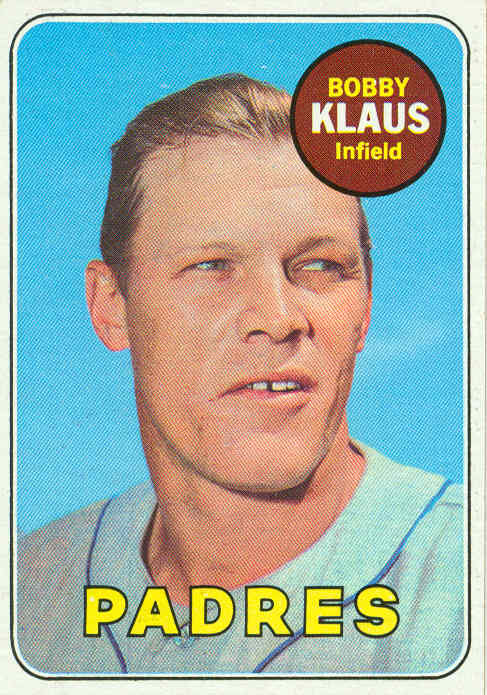
Final Card: Bobby Klaus

This is the final card for Bobby Klaus (#387). He has a card in this set, even though his last major-league appearance was in 1965.

Klaus was signed by the Reds in 1959, and played in their minor-league system for 5 seasons, the last two with the Reds' triple-A San Diego Padres.

Bobby made his major-league debut in April 1964 with the Reds, but was traded to the Mets in late July. He played for the Mets through the end of the 1965 season. Those 2 years (64-65) were to be his only time in the big leagues.


In February 1966, Klaus and catcher Jimmie Schaffer were traded to the Phillies for 1st baseman Dick Stuart. After 2 seasons in the bigs, Bobby was back with the triple-A San Diego Padres, now part of Philadelphia's farm system. He would remain there through the 1968 season.

After the fall 1968 expansion draft, the (major-league) San Diego Padres selected him in the Rule 5 draft (explaining why he has this card). Before the '69 season started, he was traded to the Pirates with outfielder Ron Davis for pitcher Tommie Sisk and catcher Chris Cannizarro. Klaus played that season with the Pirates' AAA team in Columbus before retiring.

Bobby's brother Billy was an infielder with the Red Sox, Orioles, Senators, and Phillies from 1956-63.

Sunday, September 30, 2012

Back on Topps' Radar: Billy Cowan

This is Billy Cowan's first card (#643) since the 1965 set. Cowan's career spanned 1963-1972, but he only had 5 cards during that time. Billy appeared as a Cub in the 1964 and 1965 sets, as a Yankee in the 1969 set, and an Angel in the '71 and '72 sets.

A member of the Phillies' organization from 1966 to 1968, he spent most of that time (except for the 2nd half of 1967) in the minors, effectively eliminating his chance for a card in the 1966-1968 Topps' sets.


Cowan was signed by the Cubs in 1961, and spent the next 3 seasons in the minors, finally making his major-league debut on 9/9/63. He made a half-dozen starts, spelling Billy Williams in LF, Lou Brock in RF, and a host of center fielders.

In 1964, Cowan was the Cubs' regular center fielder (I didn't know that until today), starting 127 games between Williams in left and Brock in right (with Len Gabrielson taking over after Brock's trade to St. Louis). Billy hit .241 with 19 home runs, but rarely started during September.

Before the '65 season, he was traded to the Mets for ex-Cub outfielder George Altman. In 1965, Cowan was a frequent center fielder for the Mets, until his early-August trade to the Milwaukee Braves (for infielders Ernie Bowman and Lou Klimchock).

Billy was traded back to the Cubs in late April 1966 for future Yankees' 3rd baseman and Braves' manager Bobby Cox. Two months later he was traded to the Phillies, and spent the rest of '66 with the Phillies' AAA San Diego club.

Cowan began the '67 season in San Diego, but a roster spot with the Phils opened up in late June, after the team sold Dick Groat to the Giants. With 4 of the Phillies' 5 outfielders (Johnny Callison, Tony Gonzalez, John Briggs, Doug Clemens) all batting from the left side, Cowan was called up to provide a right-handed bat off the bench.

In 1968, the Phillies' Richie Allen became the regular left fielder, creating a logjam in the outfield. As such, Cowan spent the entire season back in triple-A.

After the season, the Yankees selected him in the Rule 5 draft, marking the end of Cowan's days in the minor leagues. He split the 1969 season between the Yankees and Angels, and played for the Angels for the '70 and '71 seasons. Primarily used as a pinch-hitter, he was also a backup outfielder and occasional 1st baseman.

Cowan was released by the Angels on May 2nd, 1972, having only played 3 games that season.

Tuesday, January 24, 2012

Clay Dalrymple (#151)

Clay Dalrymple had two cards in the 1969 set - both #151. Unlike Donn Clendenon, who also had 2 cards in 1969, Dalrymple's cards used different photographs.

Clay began playing minor-league ball in 1956. He played 4 seasons in the minors, mostly with the unaffiliated Sacramento Solons in the Pacific Coast League. In 1959, Sacramento became part of the Milwaukee Braves farm system. After the 1959 season, the Phillies selected him in the Rule 5 draft.


As a Rule 5 pick, he remained on the roster for the entire 1960 season as the 3rd-string catcher behind fellow rookie Jimmie Coker and journeyman Cal Neeman.

Clay took over the starting job from day 1 of the 1961 season, making 107 starts behind the plate (88 more than the #2 catcher). He also started 107 games in 1962, and increased his playing time in 1963 (135 starts). Clay's best offensive seasons were 1962 and 1963. After that, his playing time and production would begin to taper off, then plummet in his last 2 seasons in Philadelphia.

The Phillies acquired veteran catcher Gus Triandos in the Jim Bunning trade prior to the 1964 season. Triandos had been the Orioles' regular catcher from 1955-61, and started 1/3 of the Phillies games in 1964, leaving 2/3 of the starts to Dalrymple.

Clay lost more playing time in 1965, as rookie catcher Pat Corrales joined the team as the #2 catcher. Eventually, Dalrymple was platooned, with Bob Uecker in 1966 and the start of 1967, with Gene Oliver for the 2nd half of 1967, and with the newly-acquired Mike Ryan in 1968. Ryan was a great defensive catcher who barely hit .200, but by that time Dalrymple's average had dropped to the Mendoza line as well.

In January 1969, Clay was traded to the Orioles for rookie outfield prospect Ron Stone. He would play for 3 seasons as Baltimore's 3rd-string catcher, and went 2-for-2 in the 1969 World Series. He retired after the 1971 season.